
Buck Meek with Kisser [SOLD OUT]
8:00pm
doors at 7:30
$2 off for SPACE members
_
IRL Box Office at 534 Congress St.
Cash only. No fees.
Friday 12-6 pm + Saturday 12-4 pm
Indie alt-folk songwriter and Big Thief guitarist Buck Meek comes to SPACE with a new solo record, The Mirror, and an opening set from his new rock band, Kisser.
A gleaner of the forgotten, Buck Meek tips over the familiar and turns the unknown into a companion. On The Mirror, the artist’s fourth solo record and second album released by 4AD, there’s a tender power, countered by immutable vulnerability. With an uncanny curiosity, Meek conjures twin worlds to reveal the uniqueness in the mundane. Inviting in reflection as collaborator and demon as friend, The Mirror doesn’t seek to know but to ask, looking to the shape of a question rather than the illusion of its answer.
“The more I get to know you, the less I know of love /
Is it science? Is it art? / Can I learn to give away my heart?”
Meek grew up in Wimberley, Texas. The grandson of a Shakespearean scholar grandmother and Faulkner scholar grandfather; the son of a child psychologist mother and glass sculptor father; and teenage protege to an old guard of mystic Texas songwriters and musicians, outlaw poets, acid hillbilly jazzers, and gutbucket guitarists. Meek’s first gig was at thirteen, playing rhythm for the Memphis bluesman Brandon Gist, kicking Gist’s old amp when it would short out on stage. The artist went on to cut his teeth playing Manouche, Romanian waltzes, ragtime, western swing, rock and roll, and his own songs in bars, icehouses, square dances, pie socials, cowgirl kabuki theaters, fire dances, and acrobat squats in high desert mission churches. He moved to Boston to study jazz, and quickly found community in other young “jazz musicians” who really just wanted to write songs and play rock and roll at house shows. Later, he moved to New York where he met Adrianne Lenker. The two lived in a van while singing their songs across the country before forming Big Thief.
Peeking into the corners of The Mirror’s Wunderkammer, angels fly above the bed, and demons learn to read. The lens shapeshifts––out of curiosity and out of yearn. For Meek, language is something shared, passed in cupped hands, outstretched, and spilled again––back into the river, and to the source. In “Demon,” Meek reflects this inheritance, “The more I learn the less I know / Stole that last line from my friend / Tucker Zimer-zim-zim-zimmerman / The line between us all is thin.” The record moves as an artifact of friendship, both in process and lyric. The Mirror dances loose-limbed into an unknown where shared listening is the language.
Emerging from a decade of work together in Big Thief, the partnership of Meek and producer James Krivchenia on The Mirror arrived from the idea to combine the band’s live, kinetic energy with an oblique electronic world. The pair share a school of thought that holds foundational trust in a song, to let performance be the guide. Krivchenia brought technique and philosophy from his own experimental music practice. From production projects like Big Thief’s Dragon New Warm Mountain I Believe In You, and Westerman’s An Inbuilt Fault, to his recent solo record, Performing Belief — Krivchenia’s work enlivens through electronic elements, always seeking to deepen sound. The concept for The Mirror welcomed a collective atmosphere in which simultaneous experiment could occur — the musicians responded to each other in real time, while their instruments triggered modular synthesizers and electronic magic boxes. The warmth and textures of the live band are emphasized by the electronic edge, revealing subtle parallel realities inside the recording. In merging the two worlds, Krivchenia and Meek found a shared telepathy through the process, an unspoken creative sync.
The pair looked towards the experiment, welcoming in friends, family, and longtime collaborators from ranging musical eras of life as vital co-creators. Adrianne Lenker, who contributed vocals, is Meek’s creative collaborator of fifteen years while Adam Brisbin on guitar and Ken Woodward on bass have been strongholds in Meek’s solo project for a decade. New creative partners and longtime friends like composer and ambient musician Alex Somers joined in on synthesizer, toy microphone, and piano, and Mary Lattimore brought in the sounds of her prismatic harp. A rotating cast of four drummers: Jesse Quebbeman-Turley, Jonathan Wilson, Kyle Crane, and James Krivchenia provide a wide dynamic arc of grooves. Germaine Dunes, Staci Foster, Jolie Holland, and Lenker sing as a choir on many songs. Meek’s brother, Dylan Meek contributed piano, keys, and vocals. Adrian Olsen created a wide range of sounds and melodies with modular synths.
Meek’s songwriting became compass to the recording process, instead of limiting the tracks to something controllable, he invited interaction, pulse. The album was recorded in Meek and Germaine Dunes’ log cabin studio, Ringo Bingo. While Meek recorded vocals outdoors on the front porch, looking through the living room window where the band played inside, Krivchenia and engineer Adrian Olsen were building a mirror dimension of slurm that breathed alongside the songs. With the live band emerged a kinetic immediacy that when layered with Krivchenia’s buoyant and textural electronic atmospheres, a new habitable world was formed.
Viva voce, hallowed or an afterthought, Meek captures essential human feeling with humor and sweet reverence. The Mirror searches for new meaning and the familiar is reframed through Meek’s singular voice. Love, as an idea, is always close — but in its reflection comes an afterimage of the way things could be and how they’ve been before. “In Heart In the Mirror,” the reflection takes on a literal form — “Backwards love is easier to read / When it’s tattooed on my heart in the mirror.” The Mirror steps through phases of love, from freshly formed to union, and the songs seek an infinite curiosity rather than resolution. The feedback loop takes hold in “Can I Mend it,” as self-reflection is magnified in partnership: “Can I mend it? Can I make it whole? / Now that you’ve seen into the dark side of my soul.” The answers may come eventually, but the record treats love less as confession than as study — a map of not-knowing and a reverence for those shadows of intimacy. In “Gasoline,” Meek signals linguistic play again, this time irreverently in shared company, “Making words up while we made love / one month and she’s in my blood / Ooheeah lalo, faroosee mneykro.” The record holds the absurdity of devotion, the choice to love—with equal parts ache and grin.
Lexical mirrors are handheld, tactile, and kept close throughout The Mirror — each one holding up a new truth. Language continues to spill over itself in “Demon’s” aural doubling, “I try to write a broken wing.” Meaning flickers. At once, the line appears like a healing call through the homophone of write and right, while containing within it the idea of the descriptive, the evocation of injury. Can’t it be both? On “Pretty Flowers,” Meek writes: “Show me how to come into my power without being mean / the garden weeds are making it look easy.” Meek looks for duality, finding it in the overgrowth.
These images echo thematically through the record as a lighthouse beacon, positioning the self as both subject and collaborator in a transformation where the reflection is infinite. On “Gasoline,” language arrives unformed with tender ease, layering past with new love. “We lay in silence through the morning / Until language slowly started forming / She hummed a lullaby / I recognized from when I was a newborn.” Memory gets a slippery incarnation, making doubles and threading timespaces. On “Soul Feeling,” memory becomes a site for loss and the emergence of new meaning. “Memories are disappearing / But he’s still got his soul feeling.” The song becomes a vessel to expand and contract time, moving through story and experience.
“My demon is my darkness and my darkness is my angel /
I taught him how to read, now I’m teaching him to write.”
The Mirror keeps on holding multiplicity and the line stays thin: “My demon is my darkness and my darkness is my angel / I taught him how to read, now I’m teaching him to write.” On “Demon,” mirror and demon become twin symbols for the self-encounter. Fear, darkness, and reflection are collaborators rather than enemies––versions of the self with hands waiting to be held. How can you protect the spontaneity of reflection before it hardens into self-analysis?
Before it calcifies as criticism? Before it argues for perfection? The questions keep arriving, playing with expectation, when on the other side there could be anything. The creek films with leaves, jimson trumpets, wild roses, tarmac, worms and blue jeans, love and hot air. Nearby, in one million years, a lightbeam, a warm rock and a cool breeze. When memory returns it arrives in a new body, it asks an old question. As an artist, Meek continues to reveal his singular aptitude as translator of human feeling and its endless portals. Through The Mirror, Meek aptly embraces this unknown with an abiding desire to find the right questions to ask, rather than their answers. “I don’t know the meaning of your dreams,” Meek writes on Deja Vu, “Though tell me everything.” “I don’t know the meaning of your dreams / Though tell me everything”
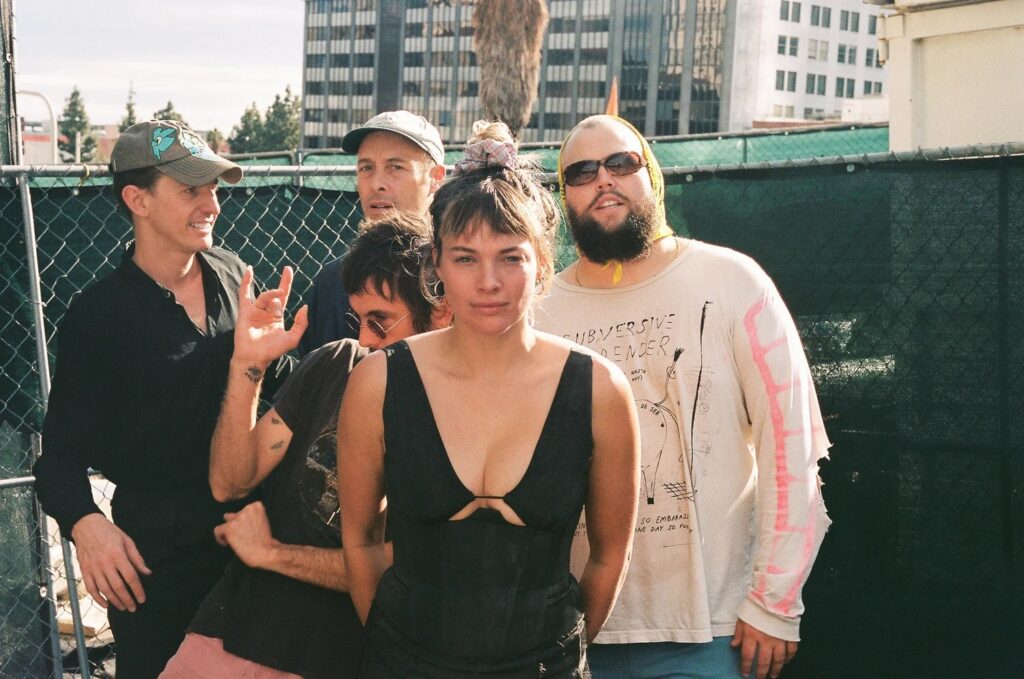
Kisser is a rock band from L.A. with Germaine Dunes, Luke Temple, Buck Meek, Jeffertitti Moon, and Jesse Quebbeman-Turley.
