
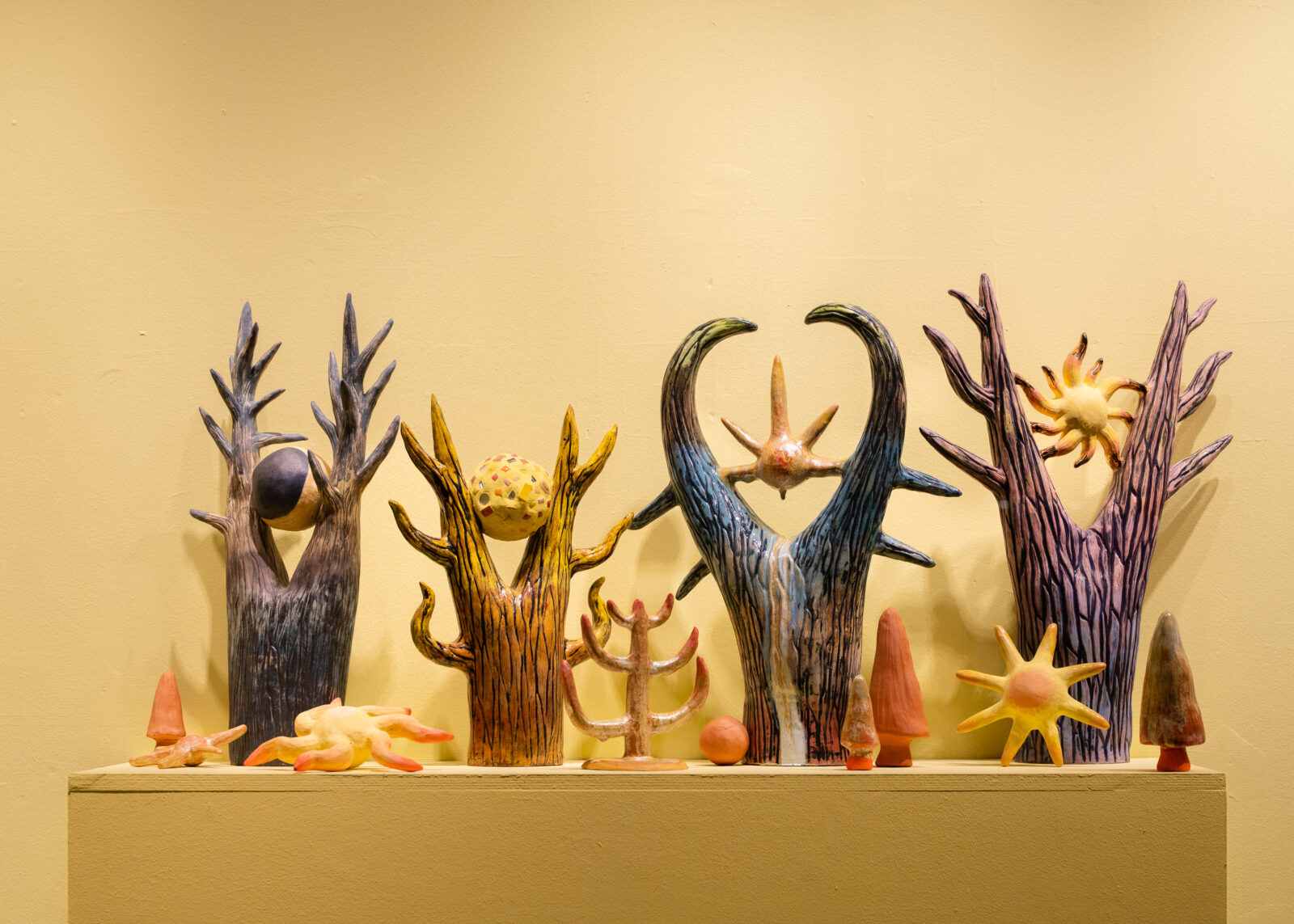
A brilliant ceramics installation of dappled-yellow sculptural arboreal and solar forms, Maine-based artist Grace Hager’s Suncatcher brought Congress Street onlookers from the spring season into the summer solstice outside SPACE.
As the installation ended its run and the summer heat took over, SPACE intern Ramona McNish spoke with Hager about moving between mediums, memory and observation, and the moments in nature that inspire her.
SPACE: Can you start by telling me a little about Suncatcher and the ideas behind it?
Grace Hager: This project really came out of the studio, which is interesting for me because the source is usually the natural world. By the time I was given this opportunity, I had already kind of stumbled upon this form of a central tree that appears to be holding either the sun or the moon. I was interested in expanding that form even further.
The inciting image was seeing the sun at sunset through a screen of trees and thinking how can I translate that into painting, but also into three dimensions. With the sculpture work there was an interesting discovery of taking something that might appear flattened— the trees in front of the sun and the sky— and reintroducing volume, so the sun became this sphere physically being propped up by the structure of the tree. I really just wanted to run with it and make almost like a tree line in itself in the window.
SPACE: You studied painting as an undergraduate before moving into sculpture. How do you decide what medium to work in?
Grace Hager: I still work across painting, drawing, and ceramic sculpture, so I’m still between two mediums. I entered grad school three years ago as an oil painter, but there was a period of time between my undergraduate education and graduate school where I wasn’t making much formal art. I was taking a pottery class and making mugs and other functional ceramics, just to stay creative and connected to a creative community.
And then it resurfaced at a moment in grad school, where I had a mentor say to me, maybe you’re overthinking painting. You’re trying too hard to paint, and you should make art in a lower-stakes moment. At that time I was really interested in shimmering twinkling light observed as sunlight on the surface of the ocean, and working with clay glaze felt like a really natural step of visual inquiry there. I started working on flat slabs, like tiles, and made installations and using those tiles to mimic water on the beach. I basically fell in love with the technique and wanted to push myself to work dimensionally.
I do actually still feel pretty evenly split between the two mediums. I think I just work in seasons. I’ll be kind of in a ceramic season for a while and then switch to a painting season.
SPACE: What time of year were you working on Suncatcher? Was it summer in Maine?
Grace Hager: The project has been a really long-held idea. The first tree sculpture was made in the late fall of 2024. And then initial conversations about the installation happened in the summer of 2025, so the majority of the making was through the fall into that spring. I definitely felt a little bit of tension later in the winter. Right now we’re approaching the summer solstice, which is a big part of this project. I’m in my season and feeling very inspired. There’s color everywhere. There’s light everywhere. But certainly in the winter time, especially if I wasn’t able to get to the studio during the daylight hours, there was a distance there. I can’t spend all day in the sun because it’s winter, but it really fuels the desire behind the work.
SPACE: As a viewer I can definitely see the desire and nostalgia in your work. especially your work regarding light which feels almost magical and childlike.
Grace Hager: I love that. There’s definitely a little bit of childlike stylization in my forms. There’s heavy geometry, simple shapes, and a lot of color.
I was really happy with how the yellow wall in this installation physically changed the light in the space. When I was installing I thought the colors seemed much darker than I anticipated, and putting them in the yellow brought the purples and blues forward which I didn’t see as prevalent in the studio. It was an amazing surprise.
I think memories are an important kind of touchstone for me because I’m not always working from direct observation. I just spent two weeks at the Elizabeth Murray artist residency in Granville, New York, and it was awesome, but I did sort of sink back into more of an observational practice, looking at a tree and drawing exactly that tree. It uncovered a recurrent or renewed interest in psychedelia and sort of hippie aesthetics, which I think that also can read as aesthetically juvenile or childlike. So I’m interested in trying to dial it up and down and get a little more specific about how much childhood and levity I want in the work.
SPACE: Have you always been primarily inspired by nature in your art?
Grace Haber: Yeah. I was raised by two research scientists, and we have two more field biologists in my family. So I spent a lot of time outdoors as a kid spending time looking at species and identifying them and talking about their unique qualities, so I think that’s really deeply ingrained in me. I can’t imagine making art without some element of nature. It’s just hard for me to keep excitement around the work if it doesn’t have that connection because that’s what I really feel connects me to a greater sense of purpose.
SPACE: And as an artist do you feel you have a different perspective on nature from your family and that scientific perspective?
Grace Hager: I’ve done a few residencies where there are other artists who are working more with hard data and have a lot of science in their visual practice. I love hearing about that, but I have a more emotional or intuitive practice. It’s like I can hold the knowledge in one hand and my feelings in the other and they meet in the middle to produce work. That’s maybe part of the reason why I’m interested in making images, because I want there to be this level of objective recognition but also the more subjective qualities of art.
SPACE: The subject of the sun is interesting because it’s very objectively recognizable, at least in the form of a circle with the beams coming out of it, even though that’s not what the sun actually looks like.
Grace Hager: I spend so much time thinking about direct observation. I try to get out and see the sunset as often as I can. And like the sunset last night was phenomenal, but you really can’t look directly at the sun because you’ll damage your eyes. So that’s another thing that feels similar to making work about the sun in wintertime, the thing you’re trying to depict is withheld from you. It maybe ties into sort of spiritual or psychedelic or awe-inspiring quality of that subject. It certainly can’t be contained in a more directly accurate way as maybe drawing a flower, something you can hold in your hand.
SPACE: As you say psychedelic again I’m inspired to ask, were you listening to music as you made these pieces?
Grace Hager: Right now I’m in a music mode. I sort of oscillate in between music, audiobooks, and movies. I’ve been listening to a lot of ’60s and ’70s rock.
SPACE: That’s really cool. What films were a source of inspiration for you while making Suncatcher?
Grace Hager: I absolutely love movies and television. In so many ways the hierarchy of the arts has been leveled, and we’re talking about all kinds of art and cultural production, but I feel movies can still be maligned so I love to bring them into conversation. We all live in this fast taste image culture.
One that came to mind right away that I watched while I was making Suncatcher is Sunshine. It’s a film by Danny Boyle and Alex Scarlet, a science fiction film where members of a space mission crew are attempting to save the dying sun, but as they get closer to the star, the proximity induces a worship-like madness. They all start to lose their minds, which is also sort of interesting when we’re thinking about the sun as a subject that you can’t directly look at.
Throughout the movie there’s really beautiful visuals of concentric circles, a lot of gold and bright light. I love a good strong narrative but what I really like about film are those like really lasting singular stills.
SPACE: Is there anything else you’d like people to know about the installation?
Grace Hager: I am just really excited that the culmination of the show is timed with the summer solstice. Our spring into summer season here in Maine was a little bit slow, even though we had some really great days early on, and I think people were appreciative of having something so bright and sunny in the window that they could see on their commute every day. It’s been a real honor and real pleasure to have the work up.
Suncatcher by Grace Hager was exhibited in the SPACE Gallery Window from May 1-June 22. More info here.