
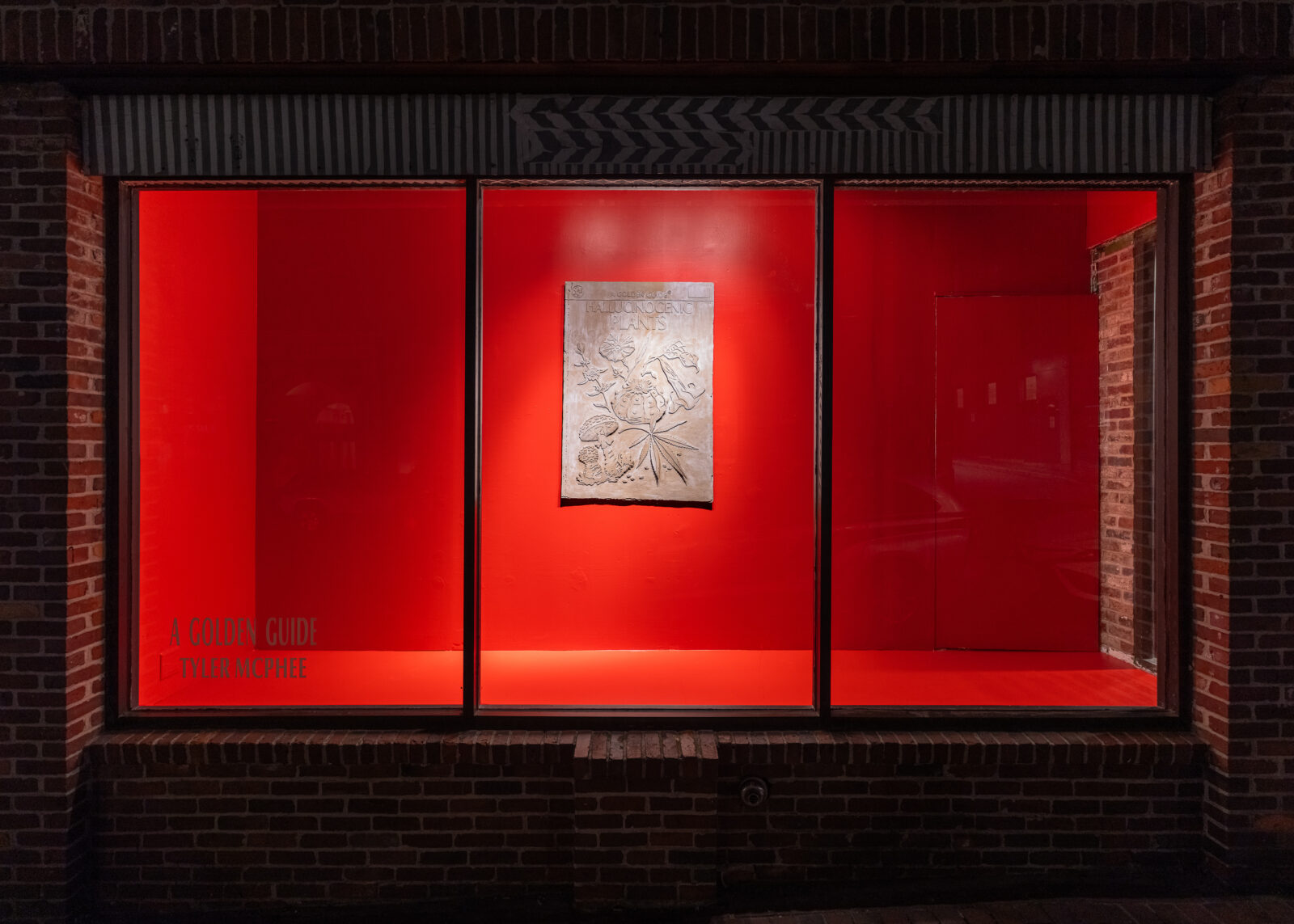
Anyone walking by SPACE this fall has been treated to A Golden Guide, a sculptural rendering of a time-worn field guide surreally and arrestingly displayed in our Window Gallery by artist Tyler McPhee. Conjuring a far-ahead-of-its-time field guide by pioneering ethnobotanist Richard Evans Schultes, McPhee’s installation catalogs the botany of altered states in a kind of deadpan visual vocabulary.
An authoritative nod to psychedelic research beset by a glowing red backdrop, A Golden Guide is effective even when it registers as merely a wink to Congress Street passersby. But the piece represents considerable research on behalf of the Portland-raised artist, who references a vast catalog of historical and cultural context for plant-based drugs.
McPhee, who lives and works between New York City and Portland, Maine, received his undergraduate education in Philosophy from the University of Maine and his MFA in sculpture from Syracuse University. He was also participant at the Skowhegan School of Painting and Sculpture. His work has been widely shown both nationally and internationally, and he has received awards from Mayer Foundation, Albert K. Murray Fine Arts Fund, Kittredge Foundation, and the U.S. Department of Education.
McPhee discussed the show’s underpinnings in ethnobotany, psychedelic research, Indigenous knowledge, government-led mind control, and the aesthetics of each with SPACE intern Ramona McNish ahead of the install.
Cover image: Tyler McPhee, A Golden Guide, Sep 4-Oct 26, SPACE Window Gallery [Photo by Joel Tsui]
SPACE: I wanted to start off by asking you a little bit about your plans for the window. How would you introduce this show?
McPhee: The show is going to be called A Golden Guide, which is based on a series of scientific pocket guides that Golden made in the ’60s and ’70s. There are books about shells, trees, and all sorts of things.
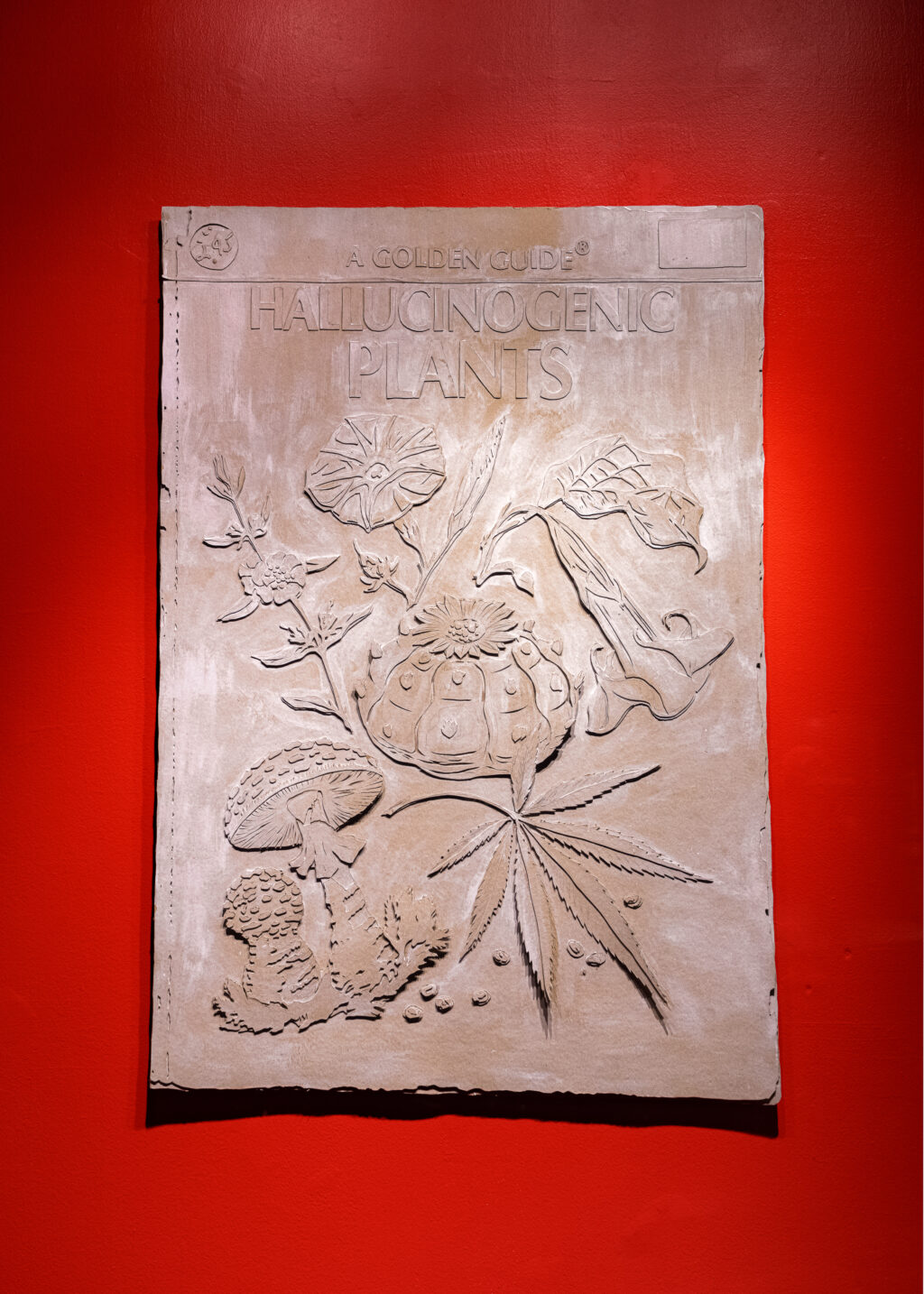
In this era of early psychedelia and psychedelic research, there was a Golden Guide published called The Golden Guide to Hallucinogenic Plants, which is kind of crazy if you think about it now. But it was very much of its time. The book was written by Richard Evans Schultes, who is a famous ethnobotanist — someone who traditionally would go out into Indigenous communities and learn about plants. He was a very famous figure who held a position at Harvard from the ’30s until his death. This was just one of many things that he produced.
It was illustrated by Elmer Smith, who did a lot of this sort of academic botanical illustration. It was a really beautiful book. But given the politics of the time, they didn’t continue reprints, so it became sort of a rare item. If you’re interested in psychedelia, psychedelic drugs, or psychedelic research, people like to have copies because they’re beautiful and collectible. It’s a tiny little book, five inches by three inches, literally a pocket guide. I’ve been kind of obsessed with it. I’ve had a copy for a long time. I got it when it wasn’t expensive.
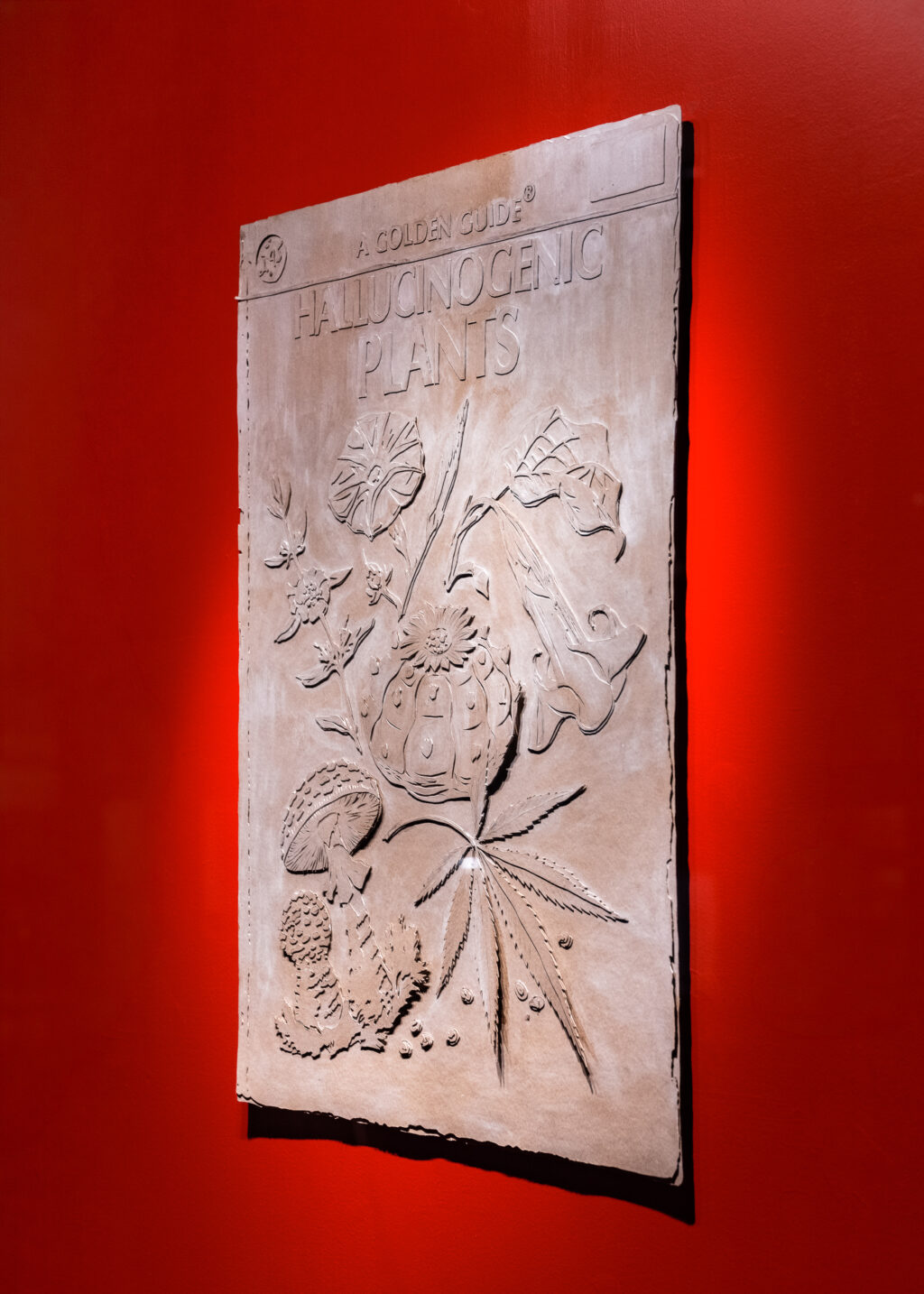
A couple years ago, I started working on a big watercolor version of it, which has a little sticker from the bookstore where I bought it and a price on it. It’s a reproduction of a book, an art object version of it. That piece became the inspiration for where I’m taking the window.
Then there will be three-dimensional paper craft versions of all the plants, these specimen-like objects, arranged on the wall. Hopefully, if we can light it correctly, they’ll have almost a mysterious or ephemeral quality. During the day, it will feel a little more staid and academic, almost specimen-like. Then at night, I hope the window begins to have this shimmering quality.
That’s the gist of the window project as it exists here. It’s also giving a nod to ephemera. The book fair, working with paper craft, and materials that you might build and construct books with. There are overlapping themes between the materials and the subject matter.
In terms of both the subject matter and the materials, we’re in the midst of a new psychedelic research renaissance. Part of why I want to highlight these plant hallucinogens is that they come from these very long historical lineages. That’s something we should keep in mind as they become mainstream in a pharmaceutical sense. They all have these really rich cultural histories that are fascinating and should be elevated and regarded.
SPACE: When you say cultural histories are you talking about Indigenous people?
McPhee: Yes, but psychedelics often have different ways of coming into our culture. Like with the Colorado River toad, which produces a hallucinogenic as a defense mechanism. Scientists found that out in the 1850s in that era of natural history. LSD was first produced in the 1930s in a lab.
SPACE: That’s so interesting. How did you first hear about the book? Did you come across it in the wild?
McPhee: Yeah. I’m kind of obsessed with old science books and ephemera. I have a collection of over a hundred books on the history of drugs from the first era of psychedelic research. They’re about psychedelic therapy, plants, chemistry.
I just saw this book one day and thought, that’s so cute. It’s such a fascinating little book. I knew I had to have it. It was just one of those serendipitous things. It drew my eye, and then I brought it home.
I love thumbing through it. Schultes is very comprehensive in the way he writes about the plants, the people, and the cultures that they come from. It’s become this touchstone where I’ve always wanted to do something with it because it’s a little book that packs a big punch. It’s kind of like the plants themselves — they may or may not be eye-catching or appealing, but they can produce these big, catalytic experiences for people.
They can cause people to undergo major changes in their lives and potentially help them heal from different things they’re experiencing. I think there’s a little bit of magic in the form of the book that I wanted to explore.
SPACE: That’s so cool. Have you been looking at the other Golden Guides and the series as an aesthetic reference, or is it more contained within the world of this specific book?
McPhee: For this one in particular, it’s really focused on using those tropes: the color, the shape, playing with the scale of the book, and playing with the scale of the plants while making them.
But the other ones are equally compelling. They have these slightly dated aesthetics. If you look at the book on fishes, for instance, it’s teal blue and has this evocative graphic design — the layout and the way they’re painted bring the life of the fish together.
They use common layout structures. They use Helvetica and Helvetica Bold, and they have these text boxes. They’re very much of that era. In some ways, they have almost a Wes Anderson quality.
SPACE: People will know them if they see them?
McPhee: Exactly. And then, over time, those aesthetics kind of go away. But I think the mid-century ones are so interesting and evocative.
As an artist, you’re always tuning into things and thinking: Why are they doing this? What button are they pushing? Why are they making me come back to them over and over again?
There’s something very satisfying about looking at them.
SPACE: Are there other aesthetic references you feel like you’re working through — about psychedelia in a general way? Are there other things you find yourself drawing on movies or music?
McPhee: I read about this a lot because it’s adjacent to my day job, but I think with this project, it was more that there was already a little bit of a container for what’s going on here. The wider canon of psychedelic imagery is extensive and obviously has had a huge impact across music, art, and all of these things.
I like the taxonomy and structure here — trying to put something in a container that is highly ephemeral, something that is very difficult to define. It’s something you can’t really categorize, and even having these objects in the container of the window is an attempt to somehow categorize and control them.
There’s a kind of futility to that. We’re saying, “Okay, we’re taking our best attempt here to do this,” but really, I think it’s more of an opportunity to center this small group of objects as an entry point into a much larger conversation.
It’s also a way to push back a little on the stigma and the lack of sensible conversation around drug use and psychedelics — why they can be helpful, and why, within a safe container, they can be useful for people exploring mental health, creativity, and other things.
SPACE: Yeah. It’s very interesting because you’re working with a subject that affects people’s sense of time, and plants — which are growing and moving, but you translate it to existing in this singular, stagnant moment in the window. You’ve worked primarily with sculpture over your career, right?
McPhee: Yeah. Sculpture, photography, and now more drawing and painting, partly because of space.
SPACE: Where do you work? Do you have a studio?
McPhee: I have a studio in my apartment. That’s actually part of the reason why I ended up moving back to Maine from New York. It was just hard to afford having a workspace. I was working off my coffee table and didn’t really have a place to make anything. Then right before and during the pandemic, I finally had a pretty decent studio, and then that happened and it kind of evaporated. So it’s been a little bit of a challenge to have a workspace on an ongoing basis.
SPACE: What is your practice usually like?
McPhee: I think I have a conceptually grounded practice. It usually starts from ideas and moves out toward forms.
Although, like any artist, you’re always on the hunt for things that are interesting or things that you keep coming back to. I’m often collecting materials, both ideas and literal materials to make things out of. Sometimes they just sit there in the studio looking at me, and they take a while to manifest.
It’s also that, as someone who’s pushing up against the constraints of not having a studio, I have projects that I’ve figured out intellectually but don’t have the ability to execute on right now. Some of that is just a slow burn.
I think some people start with a very formal approach, make gestures and continue working within them over and over again. If you look at what I’m working on, it’s usually not a series of things. Or if they are a series, they’re often very different within that series. It’s something I both like and dislike about my practice because it’s a little bit like reinventing the wheel. But I think that’s just how I’ve always been, and I imagine that will continue into the future.
The practice is also very materially diverse. This project is sort of a sculpture project with a print associated with it.
I’m also working on a photo series right now within the umbrella of psychedelics, where I’m photographing historical clinical sites with the hope of making a book about them.
So I’d say my practice is both materially and conceptually diverse.
SPACE: With your photo project, have you been traveling to see different places around the country?
McPhee: Yeah. I’ve photographed a couple of sites. One is the lab in California where MDMA was re-synthesized in the ’70s and then became popularized. About 200 other compounds were also made there. I photographed the house and the lab as part of this project.
I’ve also been going down to Boston. I photographed a couple of the sites where Timothy Leary and his lab were working at the time.
I’ve been interviewing people connected to those sites. The idea would be that you have a spread with photographs from the location, and then on the backside, there’s an interview about the setting, the environment of the trial.
We would talk about How did you make the space? What were the objects and architecture you had to contend with? How did you choose the music? How did that affect people’s experiences?
It’s a sculptural, architectural, historical project mixed together, with the idea that it will become a book.
I’d also love to make a record that would go with it, with a song from each location. It might not be the best thing for a psychedelic experience, but I think it would tell a story in a linear way — a different way of telling this narrative over 70 years.
SPACE: When you go to these locations, are they mostly indoors? Are they diverse spaces, or do they all look kind of similar?
McPhee: It’s a mixture. For instance, the house in Lafayette [California] —they used to get an orientation on what they were going to take at the dining room table, and then they would go out to the patio, which was a very different environment.
Whereas in Boston, the locations include a chapel at BU, a prison in Concord, and an office at Harvard.
Some of the other important locations are places like a state hospital in Saskatchewan. One of the ones I really want to photograph is where some of the LSD work happened in Maryland. That also happened at a state hospital, but toward the end of the experience, they would go and sit under a tree.
It’s really telling this complicated story about spaces, objects, and people, and how they interact with each other.
To answer your question simply: they’re as diverse as you can imagine. I’m trying to capture that so people understand it wasn’t just happening in a hospital room. People were improvising as they went to understand what was possible.
There were also fewer rules. Now it’s very formal in terms of how long you stay in a clinic and when you get discharged.
SPACE: In these spaces, do they have mirrors at all? Is that cultural narrative about hallucinogenic experiences part of the clinical studies?
McPhee: There are a couple of ways of thinking about this. One is that people are avoidant of them because they think that, when you’re under the influence, it may be scary or disruptive to be looking at your own image.
I think that’s something that patients discuss with the clinical team. Like, “Hey, we have a mirror in the bathroom. Sometimes it creates anxiety during an experience. Let us know. We can cover it up, or we can not cover it up.”
I think it’s a good question because you never know how you’re going to react, because you’re not 100 percent in control of what’s coming up. Things might be coming from your psyche that make you think, Oh, I don’t like the way I look today, and that just provokes even more anxiety, whereas earlier in the day you didn’t have that issue.
I think it’s just like anything: having an intentional way of interacting with your space and yourself.
SPACE: It’s interesting because people must, to a certain extent, come in with those preconceived notions. When you look over history, do you think the way we talk about psychedelic drugs has changed a lot? In what ways?
McPhee: Yeah. I think this conversation has really evolved into the mainstream over the past probably 10 years or so, especially since Michael Pollan’s book [How to Change Your Mind] came out in 2018. We see it in the amount of articles written in the press and just the closeness of MDMA, psilocybin, and LSD possibly all getting approved in the next year.
The hype and promise of this has just been building over time. But I think before that, it was a lot more scary.
SPACE: What have you learned from doing the interviews that you wouldn’t have suspected, or that you find surprising? I know you work in a similar field in a more scientific capacity. Has this given you a different perspective?
McPhee: Yeah. So, for the past five years, I’ve worked at a small startup that does clinical research on psychedelics for mental health. My interest has always been trying to understand the patient experience portion of this, which is similar to what we were talking about: it’s ephemeral and hard to describe sometimes.
As part of that, you’re working with a clinical team and you’re in different spaces. As an artist, I’m interested in how I’m being affected by the relationship with the people and the relationship with the music playing during these sessions.
I’m also always very cued up on the effect of space — how I’m moving through the world. It may be a positive experience, it may be a negative experience, it may be neutral, or it may evolve through the psychedelic experience.
I’ve had this sort of parallel practice in my studio, but my day job has been contributing to psychedelic research from an academic standpoint, from a research standpoint.
SPACE: That’s so interesting. Are there any other books or objects right now that are interesting you in this way or inspiring you in this way? What’s on the horizon in that manner?
McPhee: Oh, that’s such a good question. In terms of this photography project, there are some early books on government research on psychedelics that I’ve been delving into because those are areas that I want to bring into the book. There’s a book called Poisoner in Chief, which is about the CIA mind-control project. It’s really fascinating.
I’m also reading a bunch of books by early researchers, or I’ve been accumulating books by early researchers, just to understand the experience. There’s a book that I’m blanking on right now. called Inside the Mental by Kay Parley. She was a patient who became a nurse in Saskatchewan, and she was treating early patients with the doctors. She gives a lot of color to what that experience was like.
SPACE: Is there anything else that you’d like people to know when they look at the window, or that you’d like people to think about? What do you hope people take away from this?
McPhee: Yeah. I hope that the window sparks people’s curiosity to deepen their knowledge around the historical and cultural context that plant-based drugs come from—or all drugs come from.
I hope that it creates a balanced dialogue. I think there’s a lot of stigma around drug use and addiction, but there are these lineages of responsible, culturally based containers that have been around for a long time. I think giving that appropriate space is really important.
As people experience it, maybe they’ll get that. Maybe they won’t. Maybe they’ll just think it’s really pretty. But I think that’s always the thing with being an artist. You hopefully create an aesthetic that’s an opening, and people can choose whether they want to walk through that door or not.
Tyler McPhee’s A Golden Guide is in the SPACE Window Gallery through October 26 | More info here
