
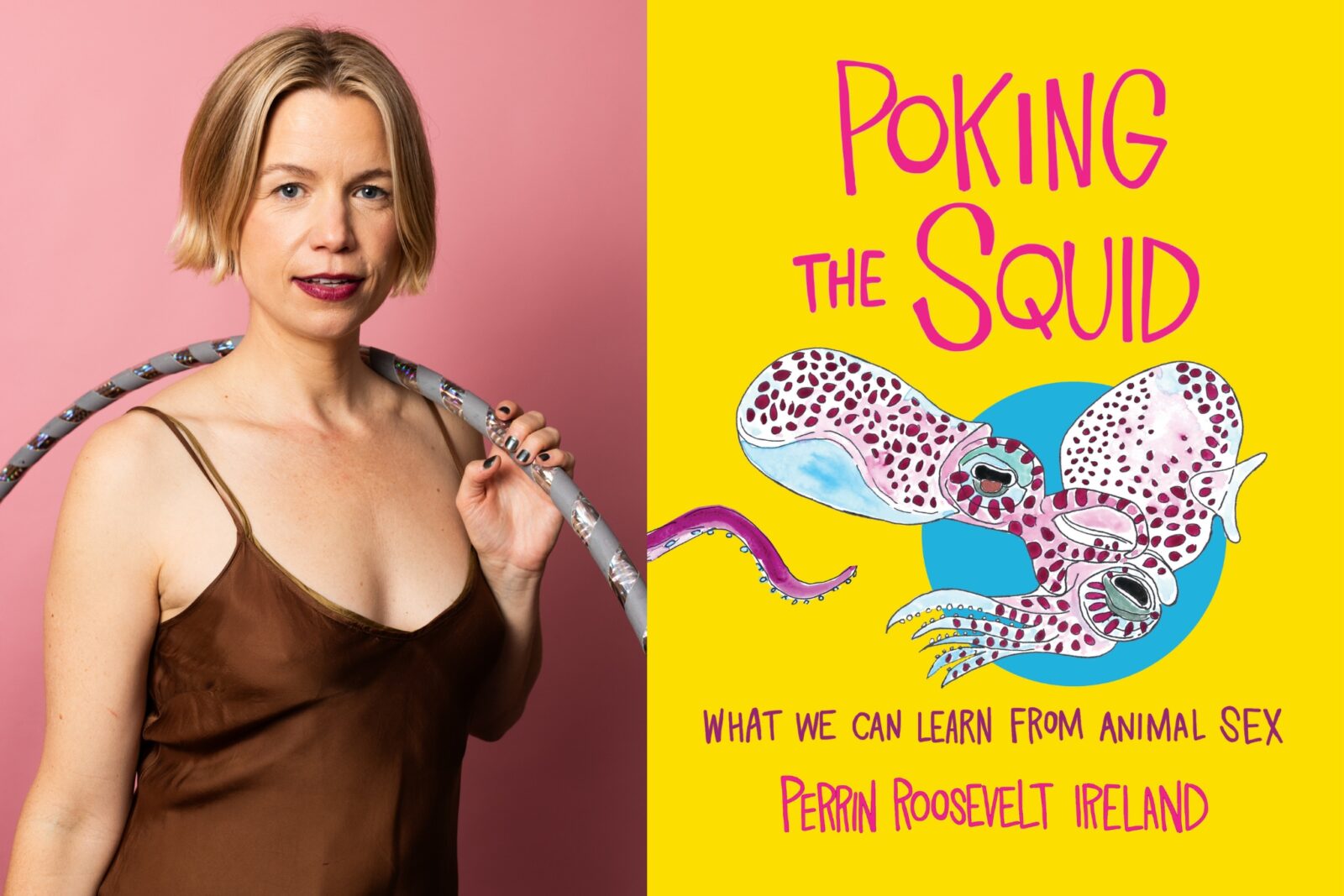
Environmental activist and cartoonist Perrin Roosevelt Ireland has spent years introducing readers to the strange, surprising, and often hilarious lives of animals. In her newest graphic nonfiction book, Poking the Squid, she turns her attention to one of biology’s most endlessly fascinating—and persistently misunderstood—subjects: animal sex.
Drawing on conversations with more than 50 scientists, Poking the Squid: What We Can Learn From Animal Sex combines comics, evolutionary biology, feminist science studies, and queer theory to explore the astonishing diversity of reproduction and sexual behavior across the animal kingdom. The book was published in June (via W.W. Norton & Company).
Ahead of her August 13 event at SPACE, we spoke with Ireland about translating scientific research into comics, the relationship between visual storytelling and scientific communication, the role of humor in environmental advocacy, and why learning about the sex lives of animals can ultimately change how we think.
SPACE: Can you tell us a little bit about your book and how you decided to write it?
Perrin Roosevelt Ireland: Poking the Squid is a work of graphic nonfiction about the sex lives of animals. My cats, Ursula and Pudge, and I interviewed more than 50 scientists to get to the bottom of what animal sex is.
I’ve told stories about animals for my whole career in a lot of different formats, and people respond really strongly to the topic of animal sex. Understandably so. It’s interesting and compelling. Over the years, especially with my performance series Thirsty Science, where I hula hoop and talk about animal sex, and at in-person workshops and lectures, people have asked me great questions and responded really strongly to these conversations.
I’ve also been studying feminist science and technology studies for over a decade, mostly with Danya Glabau at the Brooklyn Institute for Social Research, reading people like Donna Haraway, Banu Subramaniam, Stacy Alaimo, Noël Sturgeon, and others who are thinking deeply about how we make science, how we talk about animals, and what that has to do with our culture and ourselves.
I wanted a longer-form space to respond to all of those comments and questions, including the feminist and queer theory, while making sure I actually went and found the answers people were looking for. I’m not an expert, so I interviewed experts. I wanted those answers to be integrated with the theory so that we were talking both about the leading edge of animal sex research and queer and feminist interventions into knowledge production in biology.
So it’s an R-rated Magic School Bus ride through a lot of different topics in animal sex, including monogamy, female agency in sex, queer animal behavior, and sex change. I hope it’s really sharp on the science end, but that it goes down easy because it’s fun comics.
SPACE: The scientific literature and concepts you’re communicating are often pretty dense or specific. I’m wondering what the process of translating—or choosing what to highlight—looks like when you turn that research into illustrations for a more general audience.
Perrin Roosevelt Ireland: Science has had a relationship with illustration for a long time. Many of the first formal scientists illustrated their own work. Darwin, for example, did a lot of his own drawings while he was on the Beagle developing his theory of evolution. There’s a long history of telling science stories through images.
I think of it less as simplification and more as augmentation. For me, I actually have to understand the research more deeply to make comics about it. If I’m going to depict, without relying on text, the way a monkey has sex or the particular way a barnacle reproduces, I have to really understand what’s happening instead of just rephrasing a journal paper.
A lot of what I would do is read theory, social science, anthropology, and critical theory alongside scientific journal papers. Then I’d let everything settle. I don’t quite know how to explain it, but I’d know I wanted to cover a particular topic, and it would sort of swirl around above my head while I went about my life. I’d swim my laps, go to my studio, do other things, and eventually I’d land on what actually needed to be said about that paper in the context of the questions people have asked over time.
I also find Lynda Barry’s books Syllabus and Making Comics really helpful. When a story feels too complicated or too stuck in my head, her exercises help me get it into comic form.
I also spent a lot of time explaining these ideas to friends over dinner, knowing they weren’t scientists. That helped me communicate the important points more clearly, and the questions non-scientists asked helped me tell the story more fully and effectively. Then I’d turn it into comics.
SPACE: When you were workshopping the book, was there anything you found that was a particular gap in scientific communication? Was there a place where the general public’s understanding felt especially limited that you wanted to address?
Perrin Roosevelt Ireland: Yes. This is something I talked about with a number of scientists and a historian of science, and they actually voice this concern in the book too.
Right now, we’re watching the term “biological sex” be used outside of science to restrict human rights and trans rights. But what I found in my research is that sex means many different things inside science. It means different things in different animals and even among researchers studying different species.
The evolutionary biologist Sam Sharpe explains this beautifully in the book. They talk about how each scientist knows what “sex” means in their own study species, but they don’t necessarily make that explicit translation when they communicate with the wider scientific community or the public. They aren’t always saying, “When I use the word ‘sex’ in this animal, I specifically mean these three things,” even though those three things may work together in a very particular way.
For example, you might have one set of genetic characteristics, another way the body or genitalia develops, and another hormonal pattern, and those combinations can be very different across species.
I think being as specific as we can when we communicate what we mean by sex in animals will not only better represent the incredible diversity of life on this planet, but also help reduce harm to humans.
SPACE: When you were trying to communicate these ideas—bringing together biology with queer theory and gender theory—how did you think about the language you chose? Did you say “male” and “female”?
Perrin Roosevelt Ireland: There are lots of different ways to refer to these differences, so it can start to feel really cumbersome. One of the things I try to emphasize throughout the book is that we don’t really have the right language to contain this incredible diversity. We’re constantly coming up with approximations or well-intentioned best efforts.
There’s a book called Mate Choice that uses terms like “courter” and “courtee,” or “suitor” and “suitee,” or “sperm giver” and “sperm receiver.” But then you run into the question of when that language is actually being more inclusive, and when it starts to confuse or alienate general readers.
What I really tried to do throughout the book was avoid automatically pairing particular genitalia or behaviors with fixed gender or sex categories, while also keeping the language as accessible as possible. At the same time, I keep reminding readers that these words can’t fully contain what’s actually happening.
Talking with people like Sam Sharpe was really helpful. I asked whether the categories “male” and “female” are still useful, and Sam’s answer was yes—they absolutely can be. We just have to keep adding more detail and specificity about what we actually mean.
SPACE: Which is part of why visual art is such a good medium for this.
Perrin Roosevelt Ireland: Totally.
SPACE: Humor also seems to be an important element throughout the book. It’s very lighthearted in a lot of ways. When you were deciding on the tone, how did you settle on a lighter, more comic approach? What role do you think laughter plays in helping readers engage with topics that can feel more taboo?
Perrin Roosevelt Ireland: I think nature is the best prankster in the world. She made the world, so she’s the best prankster. Animals are constantly generating the jokes themselves, in my opinion. I didn’t really have to do much work to make this book funny because the animals are already doing wild and crazy things. Then the scientists write about those things in ways that I often find hilarious on top of that.
I’ve also never really surrendered my sort of Austin Powers, teenage-boy sense of humor about sex, and I don’t think a lot of people have either. Whatever your equivalent movie was, I think humor is a really easy way to invite people into the conversation, especially people who might otherwise feel uncomfortable. You give them a giggle, and then you invite them to consider what’s actually at stake when we talk about animal sex. The jokes really wrote themselves.
As someone who’s spent a long time in the environmental and climate movement, I also think we’re living through an incredibly painful moment. I just landed back from a book tour and landed in New York City, and there was this orange haze from wildfires that are displacing Indigenous communities who have lived on their land for thousands of years. It’s a really painful time, and I want my work to invite people to experience the relief of laughter and the joy of laughing together while building the resilience we need to keep fighting on behalf of all these animals during a sixth mass extinction. They need all the help they can get.
SPACE: Is there one especially surprising, funny, or memorable fact from the book that you find yourself bringing up over and over?
Perrin Roosevelt Ireland: There are so many.
One that really delights me is the serotine bat penis, which, when erect, is about 40 percent of the bat’s body length. Scientists couldn’t figure out how reproduction worked because the penis is much larger than the vagina. A Dutch retiree spent thousands of hours recording serotine bats having sex in a church in the Netherlands. He discovered that the bat uses its penis to move its mate’s tail out of the way and press against the vagina without penetration.
Scientists believe this may be the first known example of non-penetrative reproductive sex in a mammal. After that, the mate makes choices about what to do with the sperm—whether to conceive with it, store it, or reject it. They actively decide whether or not to take it into their body.
SPACE: I can’t even imagine what that would look like. When you’re illustrating processes like that, what kinds of visual references are you working from?
Perrin Roosevelt Ireland: I’m looking at journal papers. We’re living in a really great moment for scientific imagery. Papers often include illustrations and photographs, and increasingly they’ll link to videos.
There’s a great paper by Patricia Brennan and Dara Orbach, who are both genital morphology experts and whom I cite heavily in Part Two of the book. One of their papers actually lists YouTube videos of animal sex among its sources, so there’s a lot of material out there.
At the same time, because I’m so fascinated by comics, I’m constantly looking at what other comics artists are doing—how they’re organizing pages, making visual choices, and telling stories.
For me, my work is really a fusion of those worlds: spending a lot of time immersed in scientific imagery and conversations with scientists, fact-checking my drawings to make sure they’re accurate, and then bringing everything back into the language of comics.
SPACE: Your cats, Ursula and Pudge, are listed as your collaborators. Could you talk a little more about what that means?
Perrin Roosevelt Ireland: Absolutely. This is a book that’s deeply rooted in Marxist feminist theory, which seeks to acknowledge forms of labor that have historically gone unrecognized. I would argue that the labor of the domestic pet in the creation of a book is significant.
Pudge and Ursula were around for the entire making of this project. Many of my interviews happened over Zoom, and they showed quite a few scientists their gorgeous little buttholes while climbing all over my lap and desk.
I wanted to acknowledge the cross-species collaborative nature of my work. Animals are such a huge part of my life, and the cats were present throughout the making of this book. In the comics, they become a kind of chorus—challenging me, asking questions, or adding commentary—because they really were there for the whole process.
SPACE: How did you decide on the title? Were there other animals in the running?
Perrin Roosevelt Ireland: I searched the internet for animal euphemisms for sex and sent my sisters a long list. We narrowed it down to three favorites: Poking the Squid, Polishing the Porpoise, and Putting the Worm in the Mole Hole. Putting the Worm in the Mole Hole felt a little too abstract—and maybe a little too filthy. Polishing the Porpoise was also a bit more explicit.
Poking the Squid felt just right. It’s cheeky, but it also suggests curiosity. When you poke something, you’re probing it, investigating it, trying to learn more. That made it the perfect fit.
SPACE: After spending the last few years making this book and thinking about the diversity of animal life, what assumptions about the natural world did you find yourself questioning most often? In what ways did this research change how you view the natural world?
Perrin Roosevelt Ireland: I don’t know if it changed my perspective so much as it completely scrambled any preconceptions I had about how sex should be organized in a body. Not that I ever thought I was an expert on that, but animals really defy all of our rules. For every rule we make, there’s some animal out there—or one that hasn’t even been discovered yet—that’s doing the exact opposite.
It also deepened and confirmed my conviction that every animal is as perfectly evolved as we are for the particular ecological niche it occupies. It’s a miracle that we’re alive alongside these vastly diverse life forms.
The project strengthened my commitment to spending my life learning as much as I can about the many ways life has chosen to manifest itself in animal bodies on this planet, because it’s truly extraordinary.
SPACE: Is there anything you’re working on next after this book?
Perrin Roosevelt Ireland: I’ve been having a really fun time during the Q&A portions of my book tour. People ask incredible questions, and I’ve started working on a zine where I go find the answers to the questions I don’t already know.
Unexpectedly, that’s turning into a comic project of its own. Looking further ahead, there were just too many incredible examples of insect and arachnid sex to fit into this book, so I think the next step for me is bug sex.
SPACE: I look forward to reading it. Is there anything else you’d like readers to know?
Perrin Roosevelt Ireland: Yes. If you go to my website, there’s fun merch if you want to represent the book—or your favorite queer animal—but there’s also something called the Society to Save Slap and Tickle, which is an environmental community I’m building to protect sexual diversity in all its forms.
If readers fall in love with a particular animal while reading the book, I’ve chosen 10 animals that represent a range of ecosystems. On the Society to Save Slap and Tickle page, you can support organizations working to protect those animals and the habitats they depend on.
A good friend of mine said at a book event that the book had deepened her sense that animals deserve reproductive justice too. I loved hearing that. So if you love seahorses, you can support Project Seagrass. If you love anglerfish, you can lodge your complaint against deep-sea mining. There are lots of different ways to support these animals and help ensure they can continue thriving.
SPACE: When you talk about reproductive justice for animals, are you mostly referring to preserving ecosystems and research?
Perrin Roosevelt Ireland: That’s certainly a big part of it. I’ve also become really interested in the legal movement to grant personhood to animals, rivers, and ecosystems.
Part of what this book asks is, if we truly imagine animals as beings capable of sexual pleasure, deep partnership, romance, camaraderie, and choice, what does that change about how we think we can treat their habitats, their lives, and their right to exist and thrive alongside us? I think it changes everything.
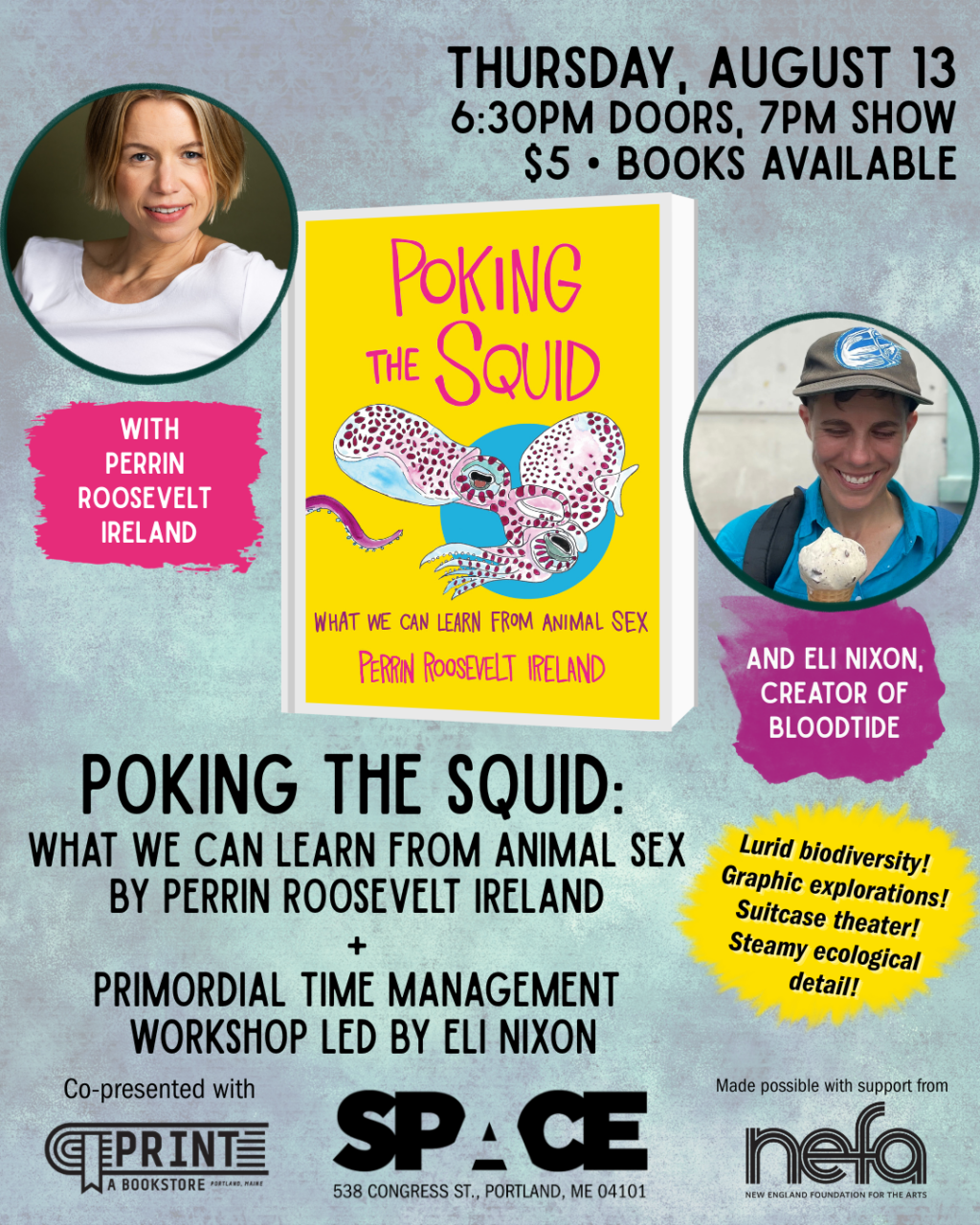
Book launch for Poking the Squid: What We Can Learn From Animal Sex by Perrin Roosevelt Ireland + Primordial Time Management Workshop by Eli Nixon | Thursday, August 13 | 6:30 DOORS, 7 pm SHOW | $5 advance, $35 includes book | Tickets at SPACE538.ORG
