
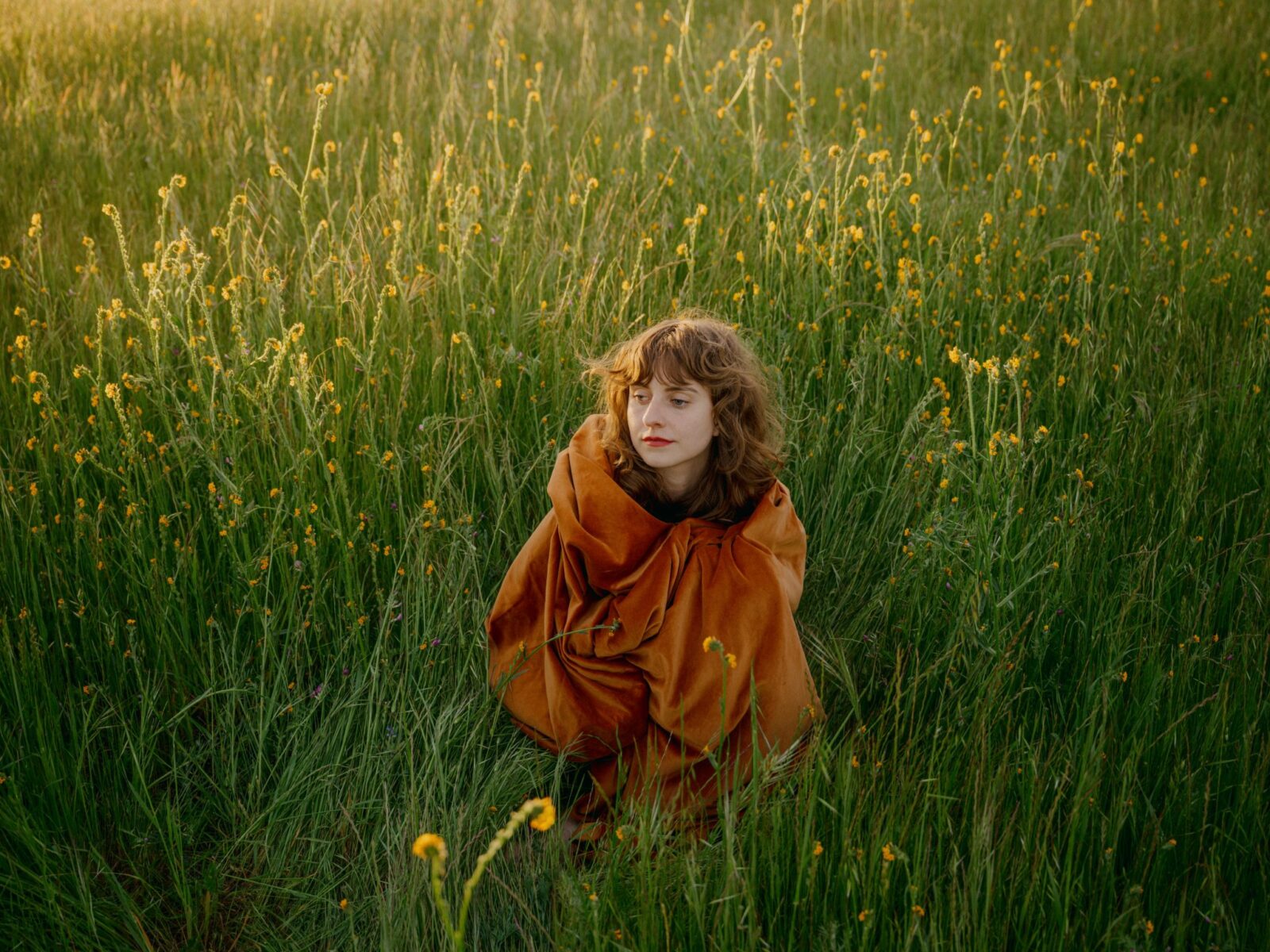
Singer-songwriter Hannah Frances has quickly emerged as one of the most distinctive voices in contemporary folk. Blending intricate finger-style guitar, delicately arranged woodwinds, and prog-rock grit into tracks that retain a deeply personal core amid expansive arrangements, there is, as NPR put it, “no one who sounds like Hannah Frances.”
Her album Keeper of the Shepherd was named one of Pitchfork’s and Paste Magazine’s Best Albums of 2025.
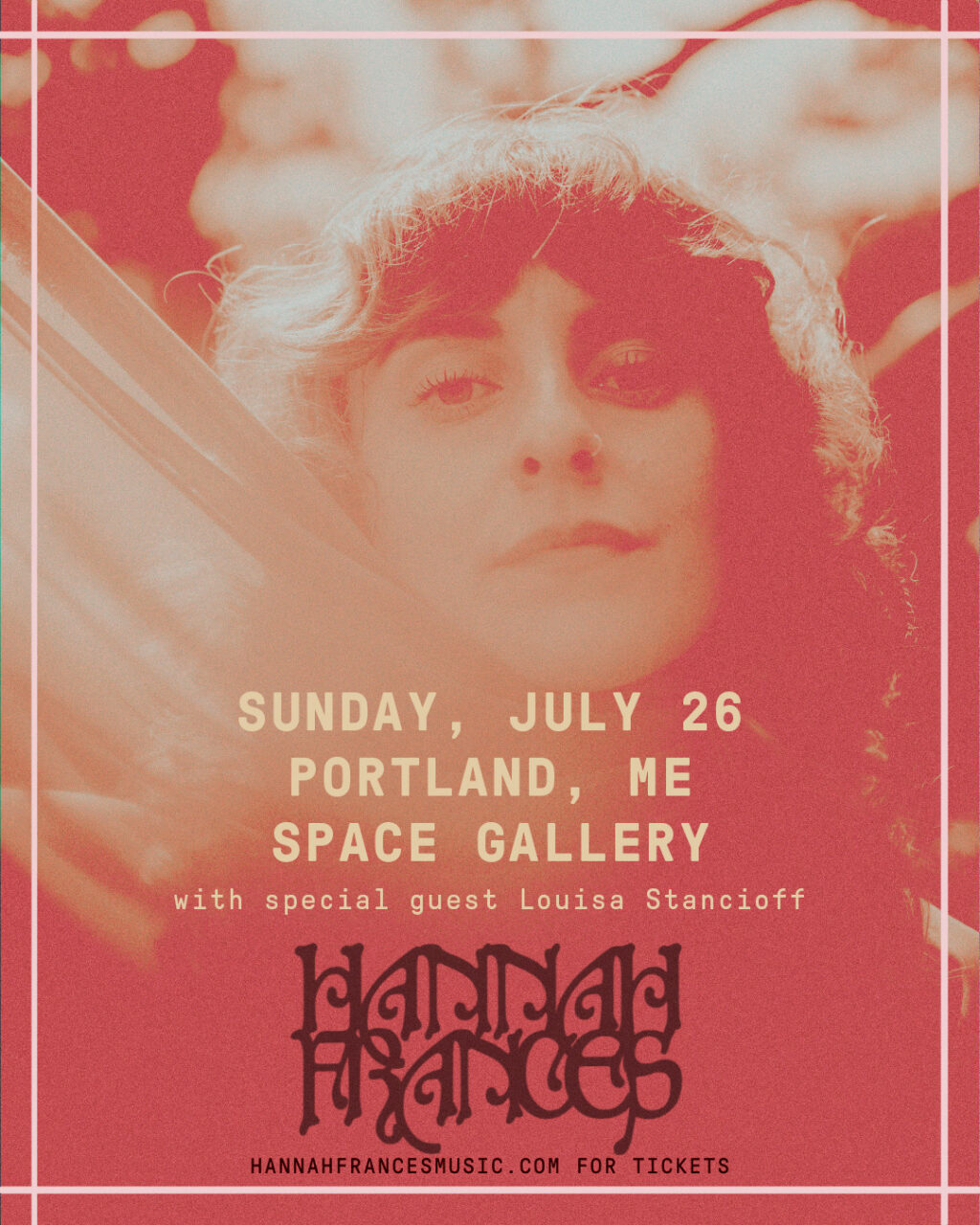
Hannah Frances will make her SPACE debut on July 26, with Maine singer-songwriter Louisa Stancioff. Tickets are available here.
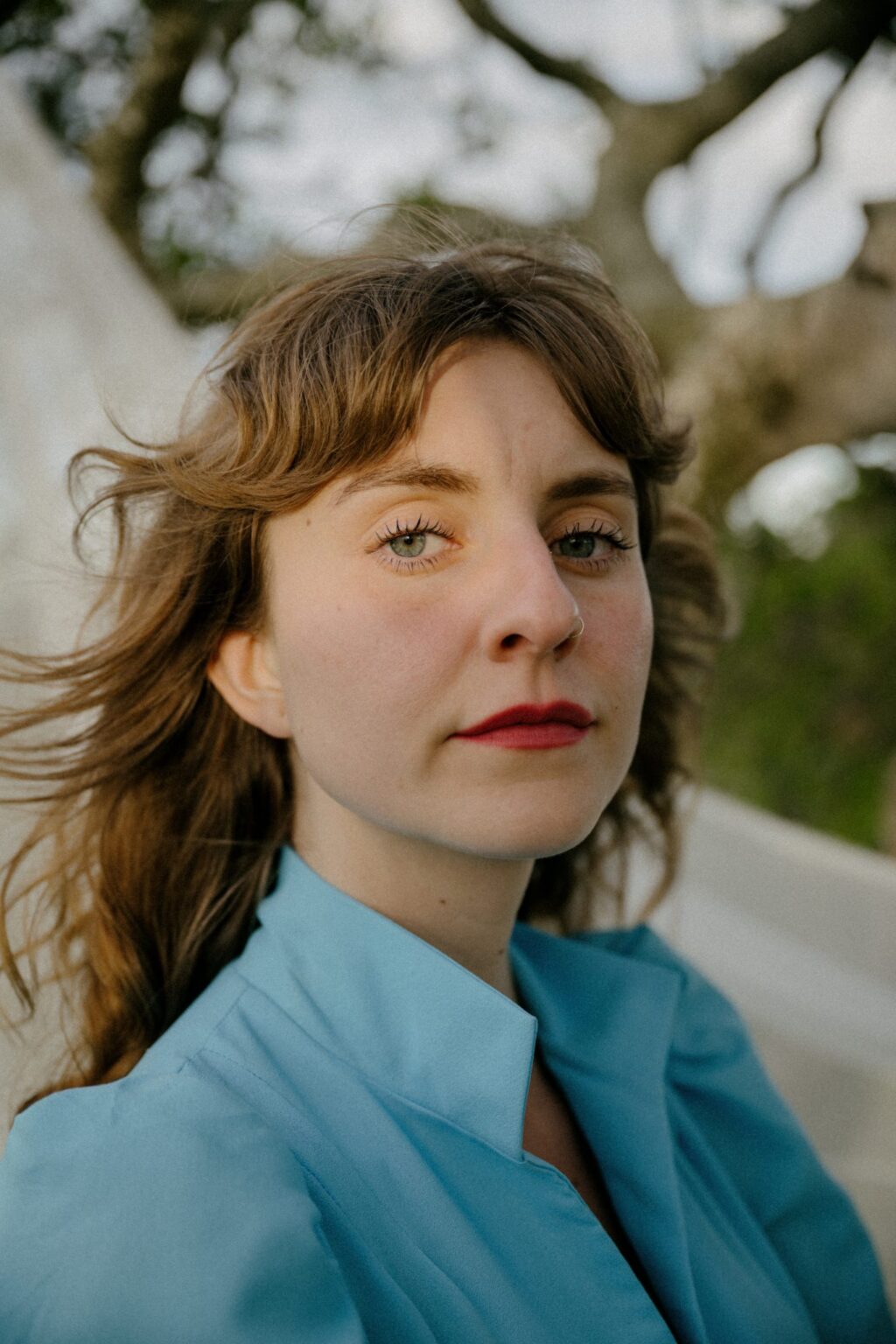
SPACE intern Liam Rodríguez spoke with Frances ahead of the show.
SPACE: Your latest album, Nested in Tangles, comes right on the heels of Keeper of the Shepherd, but its sonic world is noticeably larger with more heavy orchestration and dynamic extremes. Did you set out to expand your sound, or did you find that the songs themselves naturally demanded a broader palette?
Hannah Frances: I think a little of both. I set out after Keeper of the Shepherd to challenge myself as a composer and as a guitarist, and see what other kinds of terrains I could explore and try to incorporate some of my more progressive rock influences. Like, how could I lean even more into that?
At first, Nested in Tangles was going to be, in my mind, a lot of instrumental work. I was like, what if I just wrote like large progressive instrumental compositions? But then I think [that] naturally, I am a lyricist and a songwriter at heart. A lot of songs kept coming through and I was like, okay, maybe the record’s actually a bit of a medley. We have some crazy compositions, but then we also have straight-to-the-bone songs like “Steady in the Hand” or “Falling Firm and Further.”
I think I was conscious about wanting to challenge myself even more, in terms of composition, and also I think the emotional content and the songs kind of demanded that of me. Because of what I was writing about, they just called for the compositions to match that level of emotional intensity. I think that’s how a lot of the songs became even more expansive.
SPACE: Thinking lyrically, does the process of writing your songs usually begin with answers, or questions you’re living with? Do you see songwriting as a way of discovering something about yourself, or putting in concrete form something that you’ve already figured out and already grasped?
Hannah Frances: That’s a great question. I think ultimately I sit down to write, to ask questions, and do a lot of deeper inquiry into myself and my own patterns and challenges. When I’m feeling complicated, songwriting is a place where I ask a lot of questions. In some songs, there’s maybe a sense of resolution, and then some songs end with questions, where there’s no real resolution, and often times the music reflects that as well. It gets unresolved, or it’s very much a song of inquiry.
A lot of the time I’m a very self-analytical and reflective, inwardly-searching person. So my music is definitely the space where I’m asking myself a lot of questions. Songs kind of spark by some sort of clarity where I’m just like, oh god, I didn’t even realize that, and then I want to explore that further.
“Keeper of the Shepherd,” that song in particular, is very much a declaration of like, “this is what I want and this is what I don’t want.” I think some of my songs really go in that direction too, like a floodplain. That experience of this is coming from a sense of clarity about relationships, or something within myself that I wanted to call into existence. I think “Keeper of the Shepherd” touches on that kind of energy more than inquiry. Keeper of the Shepherd is like a series of clarities and final clarities after a period of not knowing and asking deep questions.
I would say Nested in Tangles is where I’m kind of in the muck of asking a lot of really difficult questions. Nested in Tangles is a lot more of an inquiry album, if that makes sense.
SPACE: You mentioned Keeper of the Shepherd as a declaration. Thinking as a songwriter, it’s almost a kind of relationship where you might come into a song with a clarity or calcification, but then the writing itself responds to you. Perhaps with a sense of “Oh yes, this is what I believe,” but you can assess it and ask, “does this feel right? Does this feel good?”
Hannah Frances: Definitely, and I’m very intentional about what I immortalize in a song. I don’t say anything that I don’t want to listen to in 10 years. I want to write songs I can grow into.
I think sometimes at least in my own journey, even if you don’t fully believe something, but you want to grow into it as like your higher self or like your best self. Sometimes songs are a space for that as well. Like, speaking into existence something that when I listen back in five years, it will make a lot of sense and potentially even more sense. So sometimes I’m also writing for my future self, trying to write something into existence.
I use the term manifestation loosely, but kind of like a mantra. Like I’m trying to work through this, and/or this is the kind of relationship I want, and so I’m gonna really put my energy into that and write about that kind of experience, and release old patterns so that I can step into maybe a new pattern. I feel like songwriting for me is definitely rewiring. It’s not casual. It’s very much not a casual process.
I try not to get too granular, just because I don’t think that ages well, and I don’t really like music or poetry that is too literal. I try to strike that balance and lean a bit more on the poetic/universal side, so that it leaves it up for interpretation, and it’s not so that songs are so beholden to one era of my life or something. That also allows the listener to have their own experience listening to my music.
SPACE: Thinking ahead to your tour coming up, it’s such a contrast to dive into yourself and craft these songs that are very personal then go and present them very publicly to an audience. Do you feel like those live experiences ever change your relationship to a song?
Hannah Frances: Yeah, definitely. A lot of the songs that I perform regularly I wrote a long time ago. My relationship to them is always changing, and the room that I share them in, the people, they definitely shape my relationship with the songs at every show. It’s really powerful. It’s like you change the air in the room with each song, and every song hits each person differently.
It’s a really beautiful experience. It’s what I love the most about touring. Touring is 90 percent just like a schlep. That’s really exhausting, but the 10 percent is so rewarding to play a show and be in this intimate room of people, and to have a conversation with them. Afterwards there’s someone who will come up to you and just say like, “Thank you for sharing that song. That song is so meaningful to me.” That happens at every show about a different song every time, and I just love that. It helps remind me that my music, that music in general, lives on and has its own life cycle and reaches new people all the time. These songs might feel old, older to me, and like muscle memory. But for a lot of people, it’s the first time hearing me share it, or maybe they haven’t heard it before, so it helps me reconnect to my music more than anything.
SPACE: I love that, and that’s very meaningful to feel like your music extends beyond you and has a life of its own. I think we’re in need of more of that: people that are sharing stories with the integrity to dive deep.
Hannah Frances: Yeah, I do think we need it. This last tour I did in May as the support, — which I also love because a lot of people in the room don’t know you. It’s a fun and vulnerable experience to reach new people, and I’m always reminded that this matters. It’s really easy to forget that in this industry. You throw finances into it, you throw the fatigue of loading in, and it’s just like there’s so many aspects to it. But then everything just silences, and you play for like an hour or less, and it’s just magic. And then you’re like, you know what? Actually, live music really matters. That’s why I keep doing it.
So, yeah, I think the world is very much in need, and I feel always humbled that people bought a ticket and left their house, and they’re there at the show, they’re present, they’re listening, and it’s a quiet room. I mean, that’s magic, and I think it’s becoming a lost art in this culture of overstimulation and people living on their phones. It’s like, just go. Listen to someone share something really deep with you, and allow it to impact you. So yeah, it feels like a huge honor to play for anybody, even if it’s a room of 10 people.
SPACE: Because now you can have a whole music career completely online, in your bedroom. You never have to play a show. But, there’s something almost spiritual that happens when you get in a room with people, and put yourself out there.
Hannah Frances: Totally, and you can have a massive following. So many people go viral, and they have a million followers, but they can’t fill a room of people. They don’t play live, probably. They live fully in this very insular virtual space. But I would rather go room to room and city to city and actually connect with humans than have a million followers. Definitely.
SPACE: Pivoting a little bit to think about the guitar because you’re such a guitar hero. Your playing has always been incredibly distinctive, with an array of alternative tunings. I’m curious as your relationship with the instrument changes, are there any specific techniques or tunings that you’ve developed to serve your songwriting?
HF: Yeah, tunings. I play in open tunings exclusively. Keeper of the Shepherd is in a lot of the same tuning, an open C. I think I utilize tunings as a way of world-building. It creates like a sonic palette, which I really love in terms of building out an album, and that’s why I did that for Keeper. A lot of them are in the same tuning because it kind of creates this cohesion. They all start to have this resonance that ties them together.
I feel like open tunings are magical in the way that there’s more possibility with overtones and resonance. But I think that my philosophy about open tunings is the emotional component. I think that they allow for a lot of intuition to come through and less intellect. You can really access the guitar in a way without knowing theory and without thinking too much, and I fully believe in that as a songwriter. That’s really unlocked a lot for me emotionally as a writer.
In terms of guitar technique, with the writing of Keeper of the Shepherd I kind of unlocked this polyrhythmic, finger-picking technique that just feels so good and so natural. I leaned even more into it, and it’s just become kind of the way I play. It’s become very much like a part of my guitar voice. So yeah, polyrhythms and my love of jazz and prog in general.
Playing with time signature changes and different finger-picking patterns creates such interesting dynamics in music, and I love that. It’s the tuning and the picking pattern and the time signature, the meter. Everything really dances together. And then you put vocal melodies on top of that, it’s just so fun. It’s like putting together a really complicated jigsaw puzzle, and I like to keep myself really disoriented. I think it’s really good to be disoriented. It keeps things alive and it keeps the emotions alive, and I think that’s why my songs have this fluidity to them. I’m always like, actually no, let’s turn around now, and then we’re gonna go back, and then we’re gonna turn around again. Keep yourself disoriented. I think some songs settle in and you’re just hanging out for the song, and I think that’s effective. Depending on what I’m writing about, I’m like this is just a waltz, this is comfortable. But I also really think in terms of my own, singular approach to the guitar, being disoriented makes your music interesting.
SPACE: I love that, because there’s this idea that you need to work within specific boundaries of music theory and its rules, but it’s fascinating to find that sometimes you get the most human pieces when you break out of that system.
Hannah Frances: Totally. Or if you don’t have the system at all, like I don’t have the system. Really, I don’t know theory at all. I don’t know anything that I’m doing. Like, yeah, I don’t know what key I’m in. I know how to count really well, so I understand meter. I understand how to read music generally because I grew up as a very trained classical vocalist. I know how to read and sight read, but as a guitarist, I very much have no system of theory. I don’t know anything in standard. I don’t know scales. I don’t know the chords I’m playing, pretty much at all. I know the tuning, obviously, and so I’m like, I’m in a C. I’m in some sort of C, but it’s probably like C minor. But that’s why it’s great.
I work with a lot of jazz musicians that have that conservatory brain, and so they really understand what I’m doing, and it definitely is like breaking out of your perceived structures or parameters. I’m really grateful that I didn’t go to music school. I’m all for everybody doing whatever they want to do and studying whatever you want to study. I think going to a conservatory is necessary for certain paths. If you want to go play in the Chicago Symphony Orchestra, you probably should go to a music school. But for me, I never wanted it. I thought about it. I think it’s easy to feel like you should have a degree in music or something to be deemed legitimate. But ultimately, for myself, I’m grateful I don’t because I don’t have any parameters to try to work outside of. I only work outside of parameters. There are no parameters actually to even work with. That’s why open tunings are so fun, because they keep you confused. You’re trying to figure things out that are inherently complicated sonically and it keeps music very alive for me. And I love writing music because there’s literally no limit to what you can do.
SPACE: Do you find that you develop your own theory, or that you’re just working off of a pure intuition and a kind of familiarity over time?
Hannah Frances: I develop a structure that my brain understands, in terms of the fretboard or whatever tuning I’m working in. My brain somehow figures it out and obviously remembers all my songs, so there’s some sort of pattern recognition that is happening. I think I have a very neurodivergent brain where I have a very strong visual memory. If I look at someone’s astrology chart — which is a special interest of mine — I will not forget it. I know complicated patterns. I can really figure things out visually, and I’ll never forget it if I look at it. I think the same goes with my hands and the shapes of chords, I think that’s just how I navigate the fretboard, purely on visual shapes. I just orient to the shape in the context of the sound, and then I just start putting puzzles together. I’m looking at it, and then I just know the sound I want to hear. I know what shape it is because I’ve unlocked that, if that makes sense. It’s very intuitive, and I’m not trying to figure it out in my mind. I’m going purely on auditory and visual learning.
Growing up, my mom, who’s a pianist and a piano teacher, was always so frustrated with me because I would never read the music. She’s like, You’re not reading that. You’re like literally sounding it out, and I was like, True, I’m literally not reading it. I know how it’s supposed to sound, and then I’m just fucking around. That would really annoy her and my piano teacher, and I was like, I don’t think this is for me. I don’t want to read music. I like figuring things out by ear, and that’s why singing was my pathway. Because I know what I need to sing melodically. I can just do that, and I don’t need to read.
SPACE: You mentioned playing with jazz musicians, and I know there’s a lot of that on the new record. I’m curious how you’re going to be approaching the material on this tour, and what the instrumentation of the band is going to look like.
Hannah Frances: I’m playing as a duo. I’ll be playing a couple different guitars, and I’m playing with my woodwind player [Sarah Clausen]. She’s a sonic artist and saxophonist and clarinetist. She will have bass clarinets, saxophone, and we’ll incorporate some field recordings. She’ll do a lot of looping, that’s why I love playing with her as a duo because she really fills out the ambiance around my songs. All the woodwinds will be there, and she does a lot of live looping. She loops my vocals sometimes, so we kind of tag team on that.
It’s really difficult for me to operate a looper and play at the same time. I give people credit for doing that. It makes me incredibly anxious to watch live. I’m like, oh god, don’t fuck up the loop. But I can’t do it live. Maybe someday, but it’s really fun to play with Sarah because she’ll loop something I do and freeze it and then do all kinds of other stuff. So it’ll be a duo, at least for the East Coast shows, and West Coast I’m making different bands in every city. So Sarah’s going to come with me to the West Coast, but I’m going to play with different drummers and bassists in every city.
SPACE: Wow!
HF: Yeah, they’re all learning the music right now. It’s really fun to play with a rhythm section. I think because of the logistical hell that is touring with a band, and the financial responsibility of touring with a full rhythm section, it just doesn’t make sense for me right now. I hope one day I’m making thousands of dollars at every show, and that’s feasible. But right now, I got one person with me, and that’s that. So that’s kind of what the tour looks like. I like playing in different contexts. Every show is generally a little different, I play with the big band sometimes, and I play solo a lot of the time too. So it just depends.
Hannah Frances with Louisa Stancioff | Sunday, July 26 | 7:30 DOORS, 8 pm SHOW | $15 advance, $18 day of show | Tickets at SPACE538.ORG
_
Liam Rodríguez is an undergraduate student, educator, and musician invested in strengthening communities and creating radical, meaningful art. His multimedia compositions have been presented live at the Performing Media Festival in Indiana and the Electronic Music Midwest Festival in Illinois, and earned Bowdoin College’s Elliott S. Schwartz Award in Composition.
