
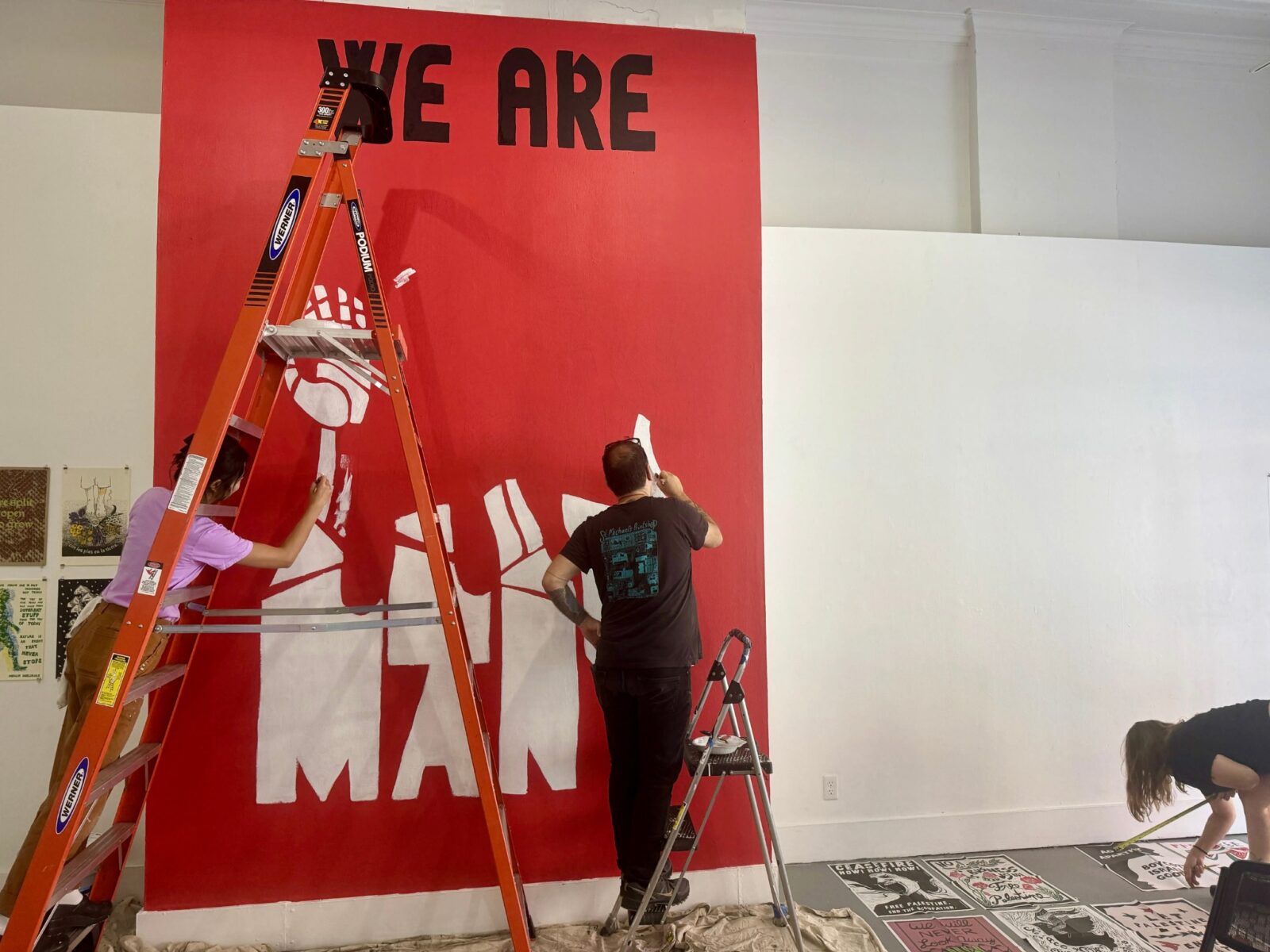
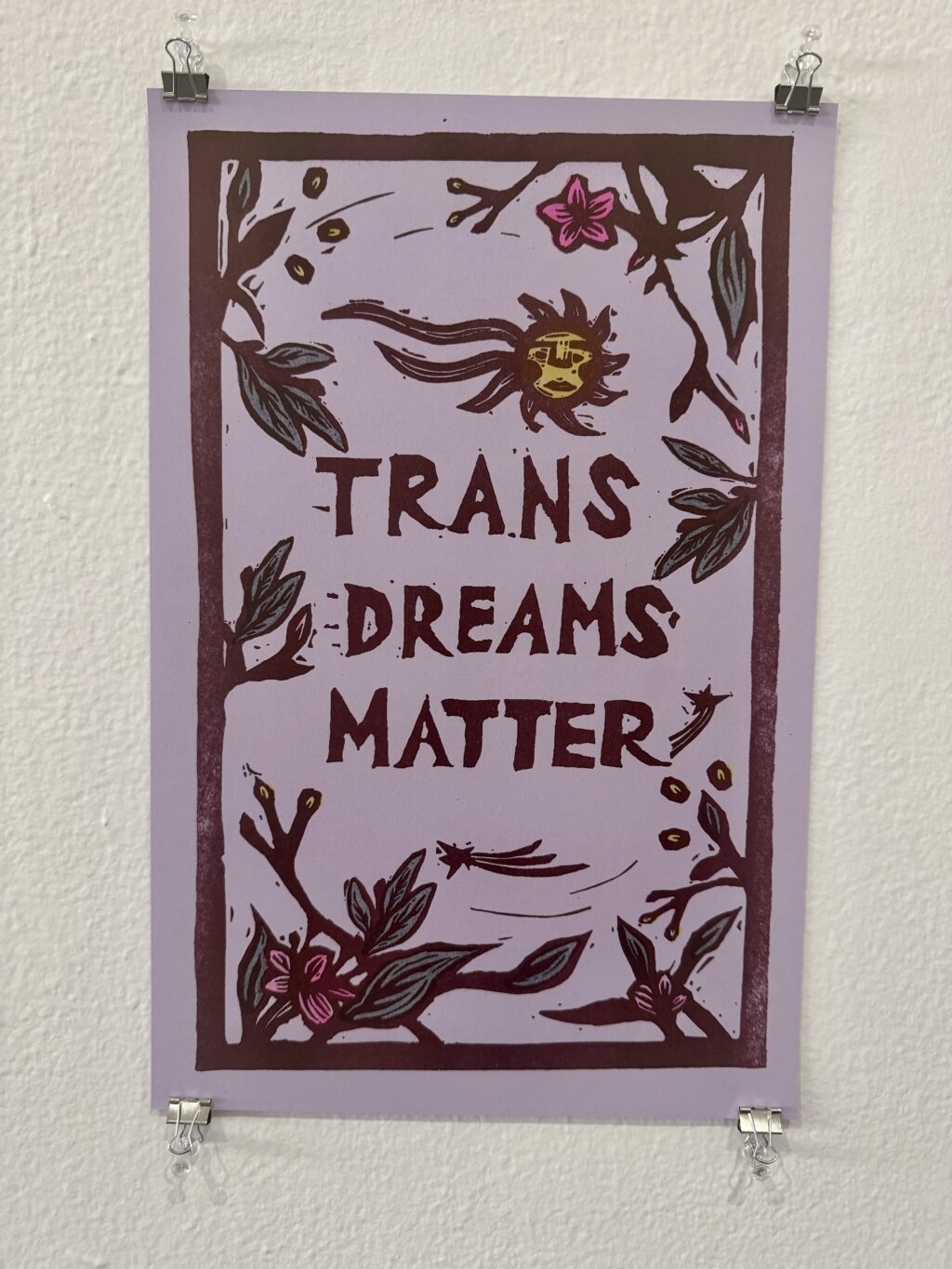
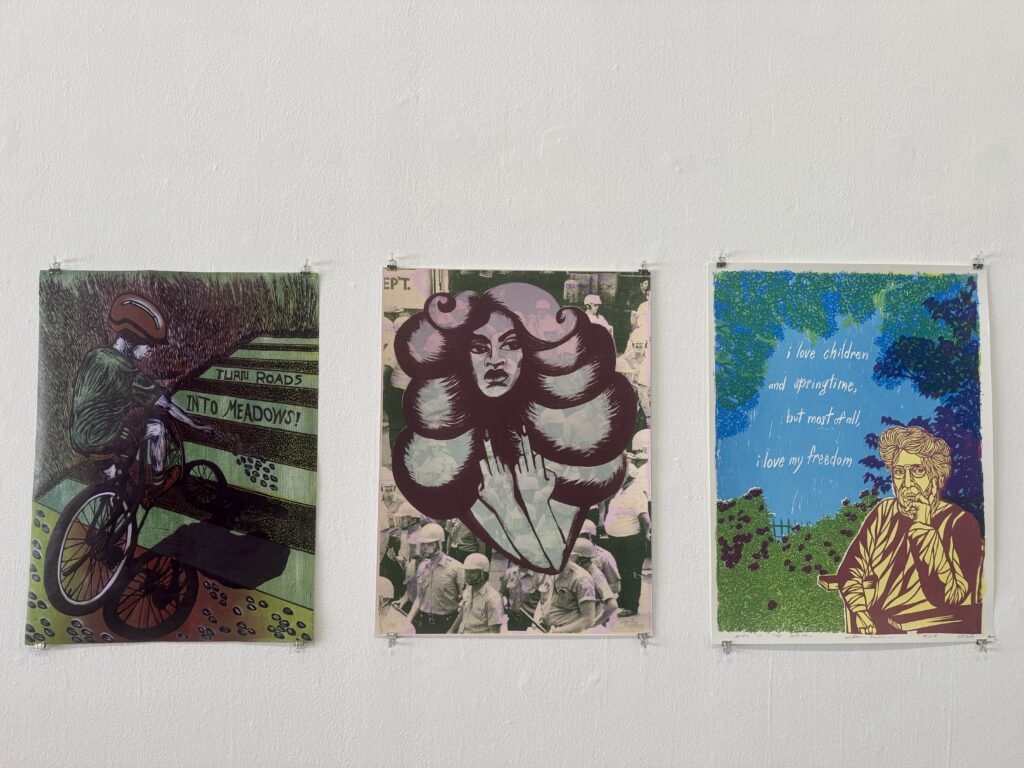
This summer, SPACE hosts We Are Many, an exhibition and sale of original prints by over 40 artists from Justseeds Artists’ Cooperative, a decentralized network in the U.S., Canada, and Mexico. The show is curated by Justseeds artists and founding members Meredith Stern, a printmaker based in Providence, Rhode Island, and Erik Ruin, a Philadelphia-based printmaker and shadow puppet artist.
Originally founded in 1998 as a graphics distribution project, Justseeds transformed into a worker-owned cooperative in 2007. A few years later, with its artists still scattered across the Western hemisphere, they moved operations to Pittsburgh, Pennsylvania, where they operate an online store and wholesale distribution center.
In preparation for the exhibition, Erik Ruin and Meredith Stern host a free gallery talk and exhibition preview on Sunday, June 28 at 12:30 pm.
SPACE interns Scarlett Downes and Ramona McNish interviewed Erik Ruin and Meredith Stern.
This interview was edited for clarity.
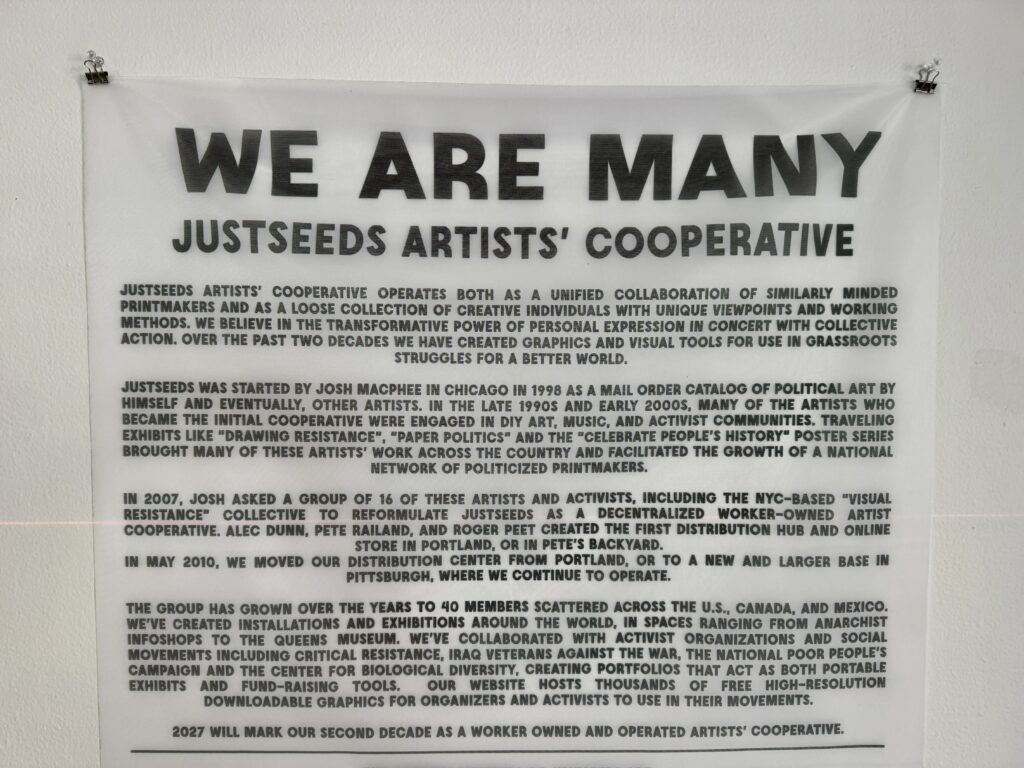
SPACE: You are both founding members of Justseeds, which is now composed of 40 activist artists. Can you talk a little bit more about what it’s like to be a part of Justseeds, where you’re connected with so many artists that share similar overarching values, but operate in different niches of social justice issues?
Meredith Stern: For me, it’s been 20 years since I became involved with Justseeds.
Erik and I are both founding members, so Justseeds has really operated as a home base for being part of a group of people who are sharing and ping-ponging ideas off of each other in a way that feels very comfortable.
It’s also a network, so some of us talk about how, since members are spread out all over North America, any of us at any given moment could go to another city that a Justseeds member is in and find a place to stay and immediately become tapped into whatever’s going on in that city. So it’s both a home base for people that we’re working with directly through Justseeds, and a way to branch out into larger communities everywhere that Justseeds members are.
Erik Ruin: Yeah, and it’s been a lot of different things to a lot of different people. Having this geographically dispersed community is a really important aspect of things.
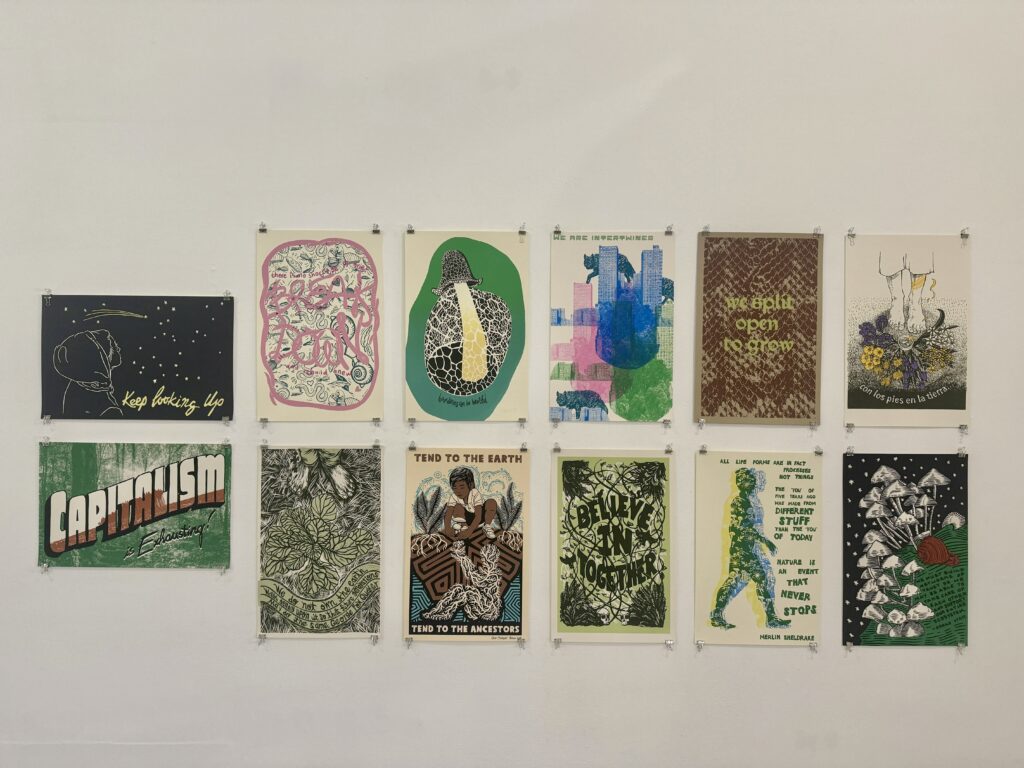
In terms of having people with different focuses in the group, a lot of us will go where we’re useful. I’m working on a piece about climate change right now and a piece about prisons, not because I have a preference for working on one over the other, but because these are the places where people have invited me into social movements where they see my work as useful.
Within Justseeds, there are different passions and perspectives, and we learn a lot from each other. I learn a lot both politically and aesthetically. Seeing how everyone’s work has grown over the past 20 years has been really inspiring, and also seeing the different ways in which people have gotten more adept at their craft or experimented with different techniques has been huge.
SPACE: You touched on this a little already by explaining how Justseeds members go where you are needed, but how does place impact what you’re creating?
Erik Ruin: There is some of that going where I’m needed, but for me, it’s also about what movements feel the most vital and exciting.
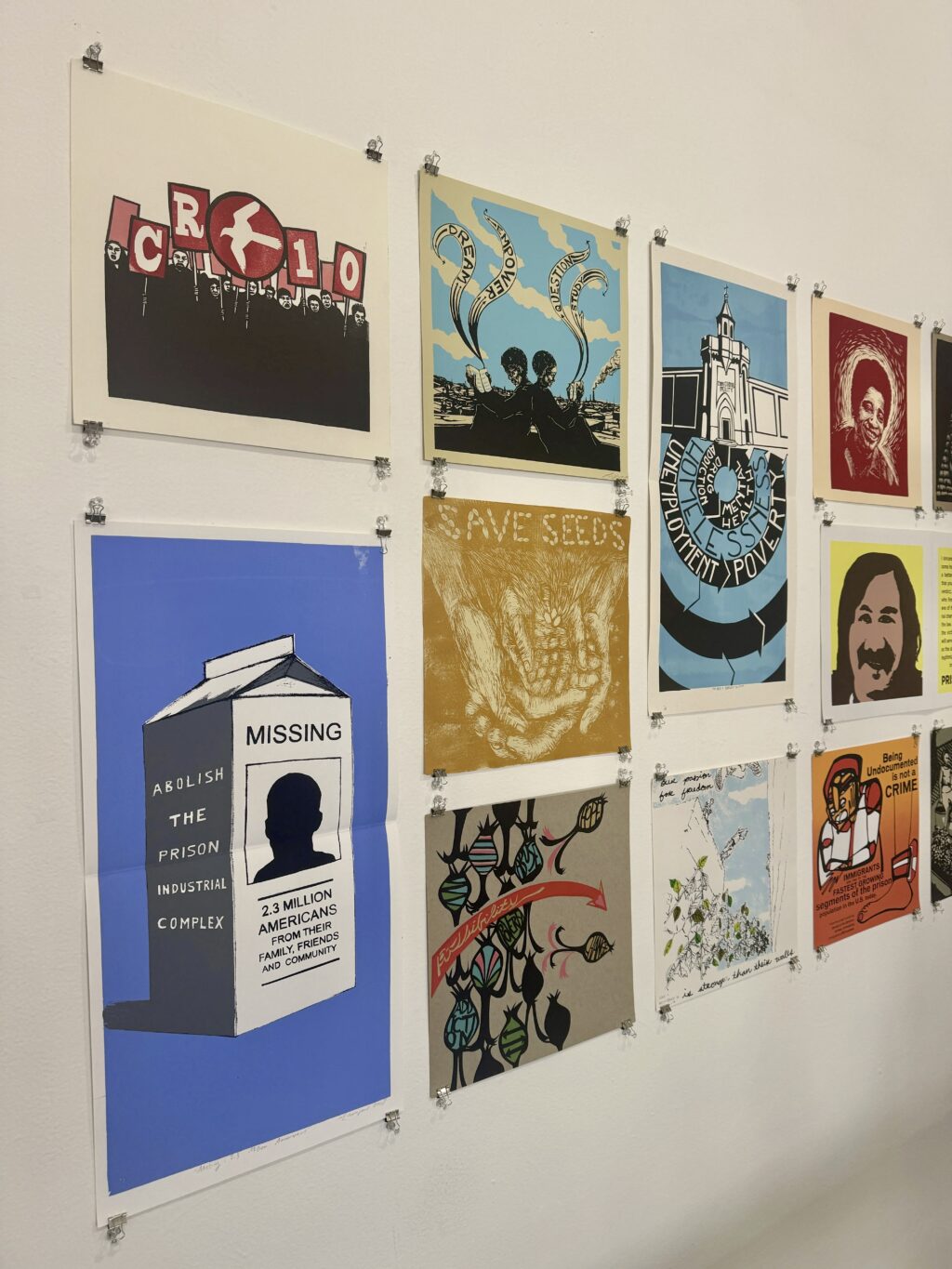
Philly, for example, has a really vibrant prison activist scene that’s very abolitionist and community-oriented, and very diverse in many ways. I’ve tended to work with folks there both because my first roommate was very involved in that abolitionist work, and because that’s the movement I’ve seen be able to hold the complexities of this current political moment the best.
Meredith Stern: It’s safe to say everyone who’s a member of Justseeds identifies on some level as community-based artists.
We’re not just artists working alone in our studio, but we’re all making work in both local and larger contexts. We’re all grounded in the cities that we live in, but also a lot of what we do is connected to national and global movements.
SPACE: You lived in New Orleans for a while, which has a really rich history and a lot going on. Do you think that living in a place with such a vibrant social justice and activist scene impacted the trajectory of what subject matters you focus on in your art?
Meredith Stern: When I was living in New Orleans, I went to school there, and then I stuck around for a while. A couple of members of Justseeds and another friend of ours started a DIY performance space that was in an old warehouse.
A lot of what the original members of Justseeds were doing came out of DIY or punk subcultures, where people were doing self-driven, autonomous projects based in community and collectivity. Many of us found each other because we traveled through or lived in different cities where members met.
I would say that it’s more that New Orleans, for me, was the place that I started making art in community, and in that sense was a hugely impactful city.
SPACE: You collaborated on a show in 2006, which was solely comprised of both of your works, making this larger exhibition for Justseeds, which is comprised of 40 people’s work, a kind of full circle moment for you two. Is that first collaborative exhibition of yours around when you two met?
Erik Ruin: I think we met around 2000, at an IMF World Bank protest in Washington, DC. Both of us were very influenced by the Anti-/Alter Globalization movement, which came about at times when we were both pretty young and being politicized.
There were these mass encounters where people would come together, and I’m sure I met multiple members of Justseeds through going and participating in this mass protest movement, which felt vital and like it was contesting capitalism at the time.
We were also both zine people, so we traded zines for a long time and corresponded a little bit. Then in 2006, just prior to Justseeds forming, we did a two-person show at a gallery in Minneapolis, where I was living at the time.
This upcoming exhibition feels very different in that we’re both older and wiser and chiller people, but also because we’re trying to incorporate the voices of 40 different people, so it’s less about our individual artistic voices.
Meredith Stern: Totally. One of the things that synchronized us together was the ‘arty’ aspect of how we were approaching protests, because we all made weird costumes or banners or signs, so we all gravitated towards each other because there was an art aesthetic that was part of the movement for us. I think that has been carried into Justseeds as a whole on some level.
SPACE: You talked about how you were both ziners, which is a great, easy way for people to speak up, share their voice, and put their foot in the door of creating activist art. Can you talk a little more about your work with zines?
Meredith Stern: In the 1990s, before the internet, zines were a really direct way to put your ideas out there, whether it was a personal zine, a political zine, or an art zine. It was a way of putting out into the world the kind of things we were thinking about and the aesthetics we were playing around with.
We’d trade them, give them away, and put them in zine distros. Acting almost as a precursor to blogs in the way that people could meet each other, they were really a way of connecting nationally with people who were also exploring DIY and punk aesthetics. They were a really direct communication method that bridged people living in different cities, together.
Erik Ruin: We both made zines that were interested in history, radical art history, and the intersection of the personal and the political. It felt like a really easy way to connect with people pre-internet and collaborate with people who weren’t in your immediate vicinity.
Whenever I met someone who I thought was really cool and had a similar point of view to me, or a contrasting point of view in an interesting way, I would ask if they wanted to do a page in my zine. It was a way of building community with people.
SPACE: What is your experience with printmaking?
Erik Ruin: In terms of printmaking, I mostly do screen printing, which is influenced by the language of block printing and woodblock printing. I think screen print is a lot easier and cheaper to reproduce multiples, and I also really like layering and transparency, which you can do in block prints, and Meredith [can do] very ably, but I find it easier to do via screen print.
I’m drawing and scratching things on acetate or making paper cuts or other low-tech ways of creating images. So it often has like a woodcut aesthetic, but it’s not.
Meredith Stern: I like the meticulous time consuming aspects of carving into a block and I do a lot of reduction block printing where you take a block, you carve some information from it, print it onto piece of paper, carve more, print it with a different color, and keep reducing the block so that you get like 10 layers of color from one block and there’s no going back. Once it’s printed, that’s it.
Eric and I both really like the craft-based approach to creating imagery. There’s a lot of meticulousness in both of what we’re doing.
Erik Ruin: I think embodied labor is a big part of it.
Spending the time dwelling with material and dwelling with our thoughts to create this deeply human form of expression. Some of my favorite times are when I’m spending a lot of time dwelling upon an image, cutting it out of paper, etc.
It’s when I get some of my best thinking done, and it has produced some of the best results. It’s also deeply therapeutic and calming.
SPACE: Will most of the art in the exhibition also embody that labor-intensive, craft-based approach?
Meredith Stern: The majority of prints are handprinted by members, and there’s a small handful of prints that were digitally produced because a few members just didn’t have an addition available to pull into the show.
We are also making a few really large-scale 2-foot by 4-foot banner collages of different Justseeds members’ work that are really beautiful, and it’s something that we haven’t yet done before. For those, people created the images through their own unique proccess, and we then digitally manipulated them to be collaged together into final banners.
Erik Ruin: It was a fun experiment to try to figure out a different way to highlight the work of the group, and also really utilize the unique capacities of SPACE as a space.
In terms of composing, I think everyone in Justseeds has a very unique way of working. I don’t know how everyone makes their images, as there are lots of different hybrid approaches, but the majority take on a pretty scrappy, DIY punk rock aesthetic.
As we’ve grown, both as individuals and as a group, it’s gotten a little more diverse in terms of how people are producing things, and we certainly don’t judge that.
SPACE: Is there a general theme for the show?
Erik Ruin: In terms of theme, the reason we called it We Are Many, which is a bit of a misquote of a Shelley poem, is thinking about multiplicity, reproduction, collaboration, and collective labor.
So that’s the theme, but that takes a bunch of different forms.
We’ll have everything from a recent news print project that was sourced from our online graphics page about Palestine; we have a portfolio about prison issues, which was actually our first collaborative portfolio with the group, Critical Resistance, who are a prison abolitionist group originally found in the Bay; we’ll have some stuff from our CSA (Community Supported Art); and we’ll have a print from each of Justseeds’ 40 members.
It’s a huge diversity of subject matters, but what unites us is the collectivity by which we’re both distributing that work, and also by which a lot of it was made.
Meredith Stern: One of the things we were exploring with the banners was what kind of imagery Justseeds members are making that can speak to the collective themes that people explore in their individual art, and put them together in a visionary way.
A lot of the images that people make are text-heavy and incorporate text and image together. The banners were a way of visualizing things without words, and exploring cooperation, community, and a vision forward.
SPACE: Is there anything else that you want to share about We Are Many to people who are curious about it?
Meredith Stern: Justseeds is now about to celebrate our 20th anniversary as a cooperative, so I think celebrating longevity.
It’s not common that self-organized, autonomous people create an institution that carries on for multiple decades. Not only that, but it’s not a non-profit, and we’re not relying on grants. We’re a cooperative, and I think within American-style capitalism, where so much of how objects and art exist in the public sphere is within a capitalist frame.
I think having art created cooperatively is a pretty radical thing, so amplifying and celebrating that is an important thing.
Erik Ruin: There’s such a diversity of subject matter and style within the exhibition.
It will be a pretty overwhelming show, so I hope people will come and come again, and really spend some time with the work.
I hope that some amount of it will really resonate with people and hopefully inspire them to make their own stuff, make their own communities, or just bolster them and what they’re already doing to participate in their communities.
We Are Many opens in the 534 Congress Gallery at SPACE on July 3 from 5-8 pm and runs through August 22. Gallery hours are Thursday and Friday from 12-6 pm and Saturday from 12-4 pm.
