
Octopus biologies, folk songs, future oral histories, the U.S.-Mexico border, the works of literary figures like Octavia Butler and Ursula K. Le Guin — all of this and more has informed the artist Sara Smith‘s ongoing project over the last decade.
The transdisciplinary artist, choreographer, and librarian, who showcased a full-scale exhibition at SPACE last winter, returns on Tuesday, June 30 at 7 pm to present Shift Again, the latest manifestation of their 10-year project Inside The Breath (In Network Time). The multidisciplinary program includes film, song, dance, and other speculative world-building elements, borrowing from literature, biological research, contemporary dance, and more.
A convergence of art, politics, and imagination, the one-night-only program serves as an encore to Red Spruce Salt Marsh Station, their SPACE exhibition in January and February of 2026. Both programs are made possible with support by the New England Foundation for the Arts.
SPACE interns Scarlett Downes and Ramona McNish interviewed Smith — a former Portland resident (and SPACE staffer in the late 2000s) now living in Western Massachusetts — about their movement practice, research methods, and otherworldly influences.
This interview has been edited for clarity and length.
Sara Smith and The Network Time Small Human Chorus present Shift Again on Tuesday, June 30 at 7 pm at SPACE. Tickets are a $5 suggested donation, and free community tickets are available. More info here.
SPACE: We wanted to start off by asking you to give an introduction to In Network Time, the project that Shift Again which will be showing at SPACE exists within.
Sara Smith: Sure. The full project name is Inside the Breath (In Network Time), and Shift Again is one manifestation of the project. It began in late 2017 as an installation performance piece. Through the years and through the pandemic, it became much more distributed and less oriented toward a single event, so there are a lot of different parts and pieces.
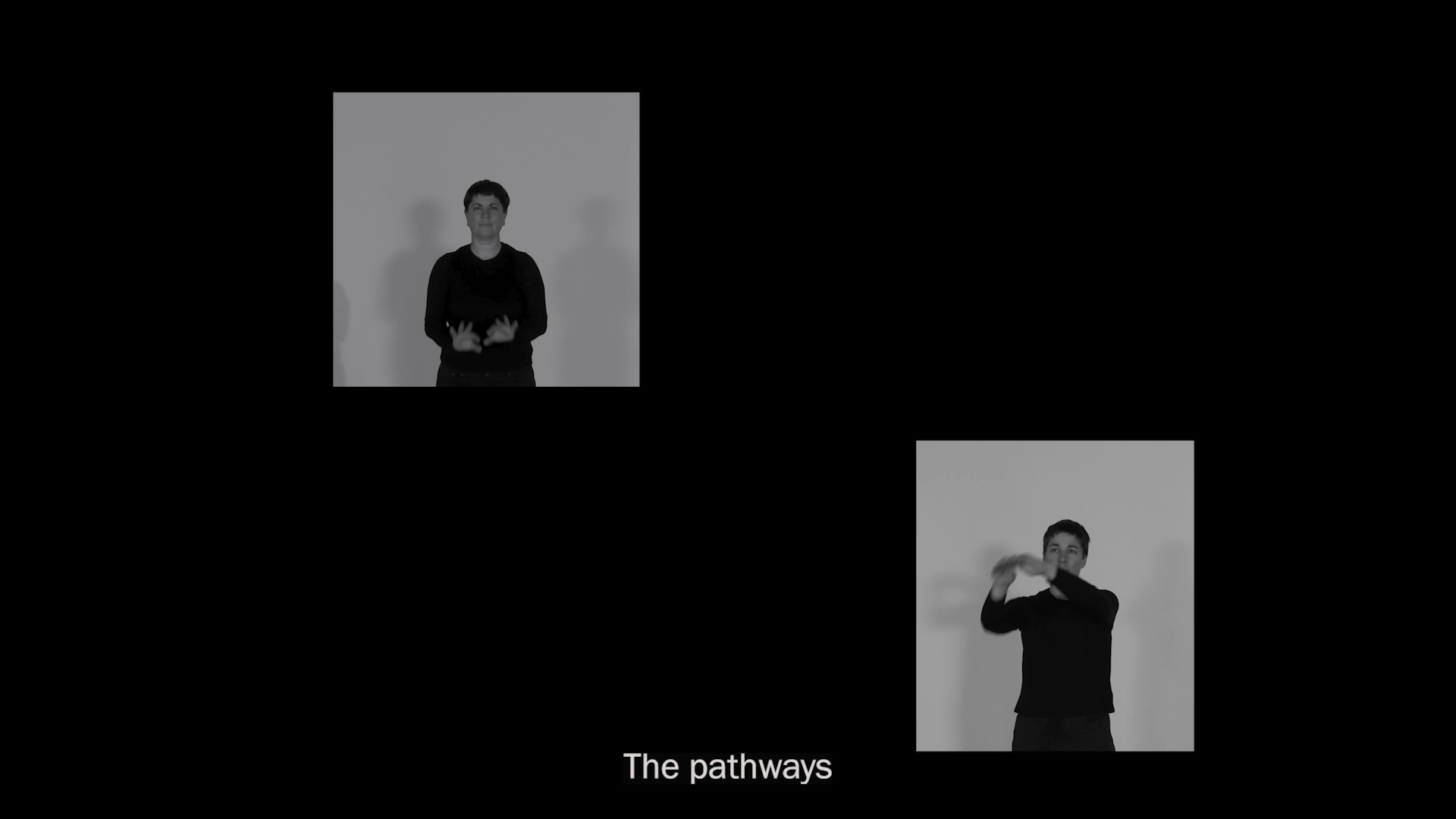
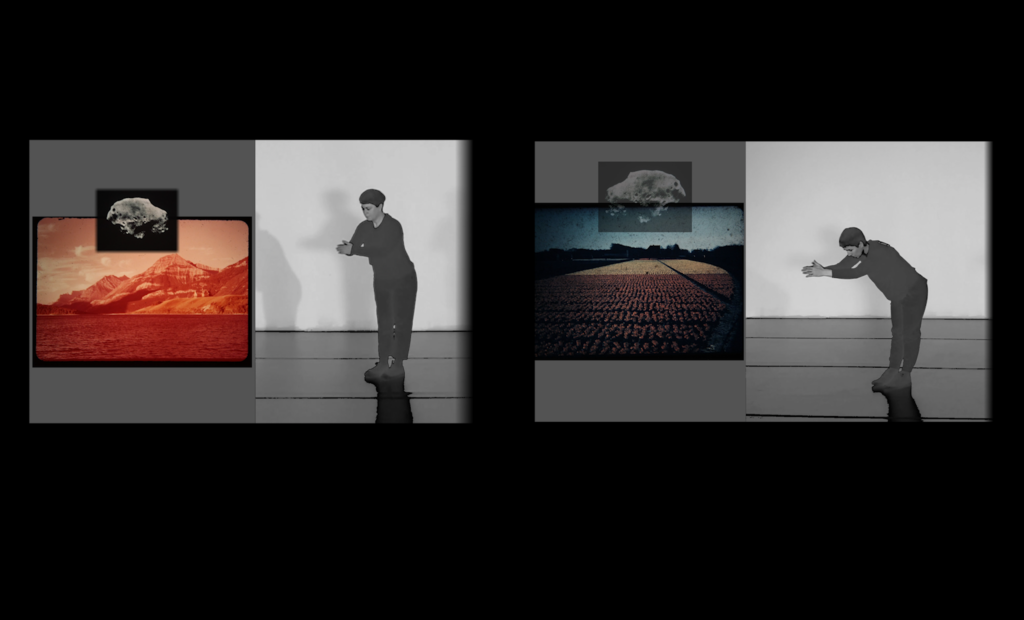
Then Shift Again is a two-channel projection video with a sing-along, which is another manifestation of the project. All of them have bits and pieces of the project content that has unfolded over the last years, but they show up as different pieces.
There are also audio pieces that exist by themselves. There are dances from the project, some of which show up in the video Shift Again. There are folk songs, parts of which we’ll be singing at the performance screening. That’s the material shape of the project.
“There’s an echo between the way we establish cultural and geopolitical borders and the way we imagine ourselves as separate from other forces and creatures. The idea is that there is no border, either physical or geopolitical, that is truly closed. Every border is porous. Everything moves through spaces.” – Sara Smith
SPACE: And there’s a sing-along component?
Sara Smith: Yeah. There’s a group of performers coming who have learned all the folk songs and all the dances.They will sing the more complex harmony songs. But there are a couple songs that are simpler, so I’ll be teaching those to everybody who comes. No one will force you, but there are a couple moments in the video where you’ll hear a tone and then we’ll all sing together. So it is a sing-along with the video.
It doesn’t really matter how well individual people think they can sing. When a group of voices comes together, it creates this shining experience. I honestly haven’t experienced anything as connective as singing and dancing with a group of people.
SPACE: And you also work as a librarian and researcher, how do you draw upon that background in your work?
Sara Smith: A lot of my work over the last 20 or 30 years has been, in some way, about the idea of interconnection. I’m always investigating different aspects of that in research.
Research in my work includes what we think of as traditional research—reading, learning about a subject—and also studio research, which takes the form of moving in dance studios, or working materially in my art studio.
Embodied training is, by its nature, about interconnection. You can’t dance in a room full of people without feeling connected to them. You’re literally having an exchange through breathing, through touch, through sharing space.
The world of In Network Time is a future space in which humans have become a much more interconnected part of the planetary whole. We’re listening with all of our senses in a much more integrated way, rather than operating as though humans occupy a larger role than the rest of the planet. It’s a world in which we are listening and cooperating with other species and systems on the planet so that we can function better.
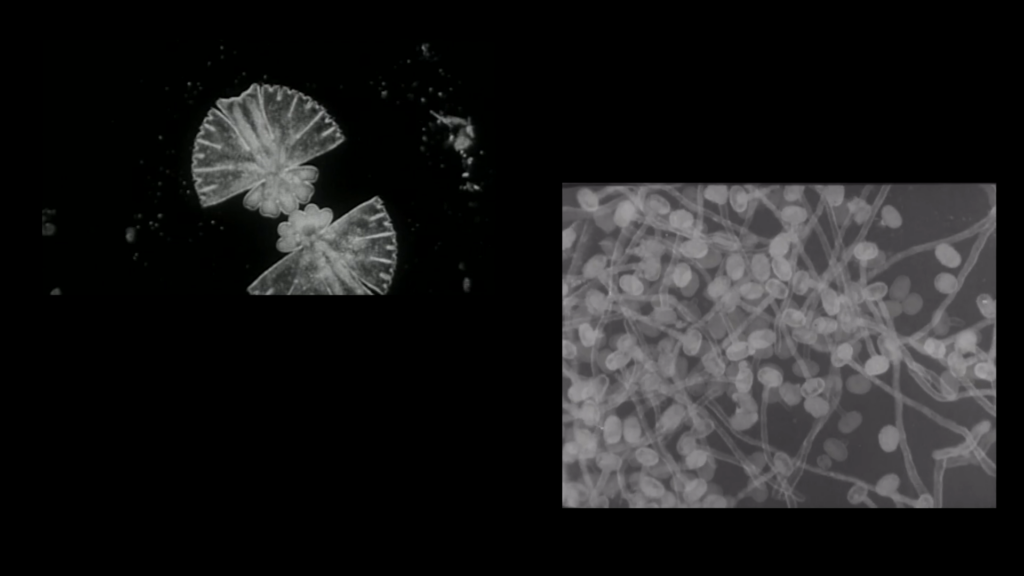
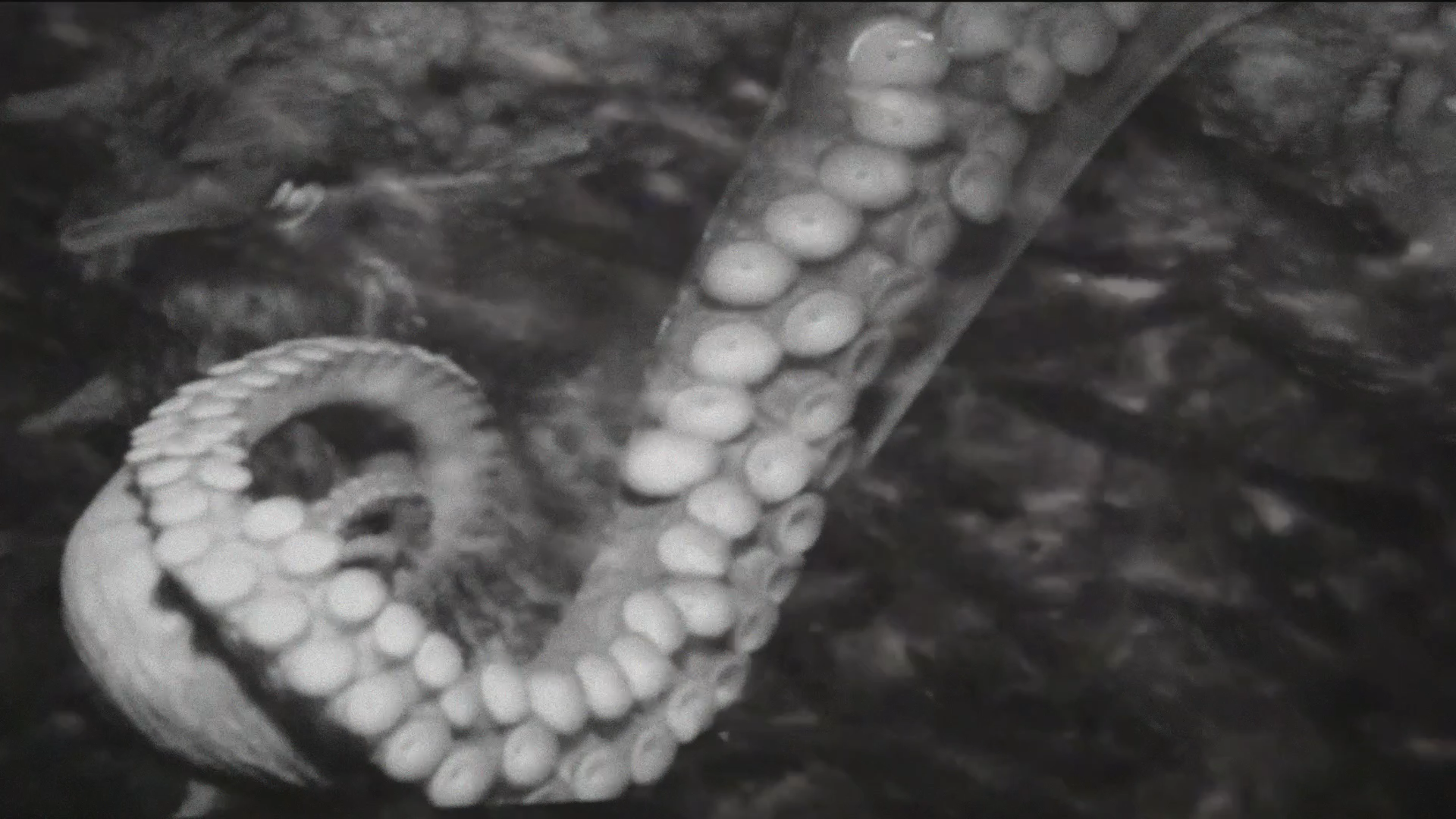
I learned about material exchange, network systems, fungal networks, bacterial communication systems, and all kinds of things that are part of planetary interconnection in order to create the world of In Network Time. Then I meshed that with the work of Gloria Anzaldúa and with learning about octopus biologies, which are also a kind of interconnected distributed system.
SPACE: When you talk about In Network Time, is the connection focused on scientific and biological connections, like fungal networks? Is there biological or technological evolution implied there, or is it more about cultural and interpersonal understanding?
Sara Smith: I think it’s all of the above, but the research has really been rooted in understanding biological connection and networks of biology.
The project I did before this one was interested in geology, tectonic plates, and physics. During that process, I had a lot of questions about what was happening biologically while all of these geologic and cosmological processes were happening. This project grew out of those questions and became about biology.
But cultural interconnection is also part of it. A major aspect of the project has been exploring the overlaps and connections between biological and social connection, and the way humanitarian and climate crises are linked.
That’s where Gloria Anzaldúa’s work comes in. She considers both the animal aspects of living on the planet and the human aspects of how we’ve set up our culture—what happens at borders and how we enforce them. There’s an echo between the way we establish cultural and geopolitical borders and the way we imagine ourselves as separate from other forces and creatures. The idea is that there is no border, either physical or geopolitical, that is truly closed. Every border is porous. Everything moves through spaces.
SPACE: You’re a choreographer, and that’s where you’re rooted. How would you say your research in interconnectedness and biology informs your physical movement practice and choreographic process?
Sara Smith: The main effect is that it’s sent me inward much more, focusing on small movements and bodily effects. Traditionally, my choreography has been much more spatial and shape-oriented. I’m a geometric thinker as a choreographer, but I’m also rooted in contemporary dance. Even when you’re making a shape, you’re feeling your scapula in relation to your spine, rooting yourself through your feet into the floor, and feeling gravity. When somebody is coming toward you and you’re going to interact with them or catch them, you’re feeling the shifts in your weight in relation to their shifts in weight.
This project grew out of a long period of physical research, and it became a question of what tiny things are happening. How are you feeling and hearing another person’s breath change as they move toward you? How is your breath changing? How is their gravity affecting your gravity?
I started exploring these questions in the dance studio by myself and then with collaborators. What happens if we close our eyes and simply feel each other while trying to move together? What does that produce? How can we connect at a smaller, more subtle level than simply looking at how someone is walking, running, or dancing in the way we typically think about dance?
SPACE: With Gloria Anzaldúa’s work, what initially attracted you to it and brought it into the project?
Sara Smith: Gloria Anzaldúa has been in my life for a long time. She’s an important editor and writer in queer literature. She was one of the co-editors, along with Cherríe Moraga, of This Bridge Called My Back: Writings by Radical Women of Color, which entered my life when I was eighteen years old. That’s how I first became aware of her.
Later she published Borderlands/La Frontera, which is a book about her life growing up on the Texas–Mexico border in the Rio Grande Valley. What was remarkable about her work was that it was one of the first texts to combine academic expository writing with poetic writing. It was also one of the first to combine Spanish, English, and Spanglish in a text that was taken seriously in academic spaces.
For those of us who work in interdisciplinary ways, she’s one of the foundational feminist and activist figures. She’s an activist, a poet, and an academic. She brought worlds together and insisted on listening to women of color within feminist spaces.
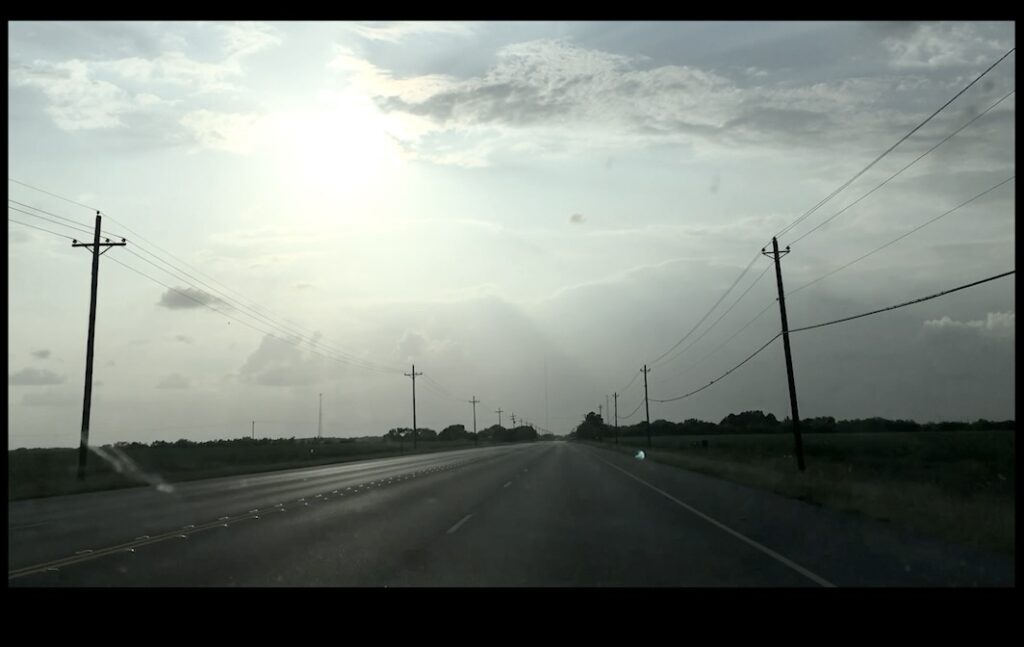
I started making this work in late 2017, partly in response to what was happening in the Southwest borderlands during the first year of the Trump administration. At the same time, Anzaldúa’s book Light in the Dark/Luz en lo Oscuro had recently been published. I was reading it during the summer of 2017 alongside a book about octopus cognition and biology called Other Minds by Peter Godfrey-Smith. As I was reading them, I kept seeing parallels between Anzaldúa’s theories about borderlands and spaces of possibility and what scientists were writing about octopuses and how their biology functions. I started wondering: what would happen if we put these ideas together? What would it mean to live according to Anzaldúa’s theories as demonstrated by octopuses? That’s what gave rise to the world of In Network Time—a future world where we actually live in that kind of mashup space.
“I kept seeing parallels between Anzaldúa’s theories about borderlands and spaces of possibility and what scientists were writing about octopuses and how their biology functions.” – Sara Smith
SPACE: How would you say translating these linguistic and academic concepts into movement and dance changes or enhances their meaning? What effect does that process have?
Sara Smith: We sometimes use the word internalize. Have you internalized these concepts or ideas? I want to take that literally. How do we make ideas that are important to us fully embodied—not just something we think about, but something we feel? I think thinking and feeling are not only linked, but are often the same thing.
When does feeling produce knowledge in a way that thinking hasn’t yet caught up with? For me, research through movement is a way of literally internalizing ideas. You can think about an idea, write about an idea, and dance about an idea.
The dancing I’m interested in isn’t “kick your leg, plié, chassé.” It’s asking: if we’re taking the feeling of this idea into our bodies, what movement does that create?
SPACE: When reading about In Network Time, I was reminded of Octavia Butler’s work. During this conversation, I’m also thinking about Always Coming Home by Ursula K. Le Guin. I’m wondering what other visions of the future informed In Network Time.
Sara Smith: Once I really got into the project, I spent a lot of time talking with people about its ideas. Many of those people started mentioning Octavia Butler and Earthseed as being very aligned with what I was doing. When I finally read it, I thought, Oh my god, it’s the same. It’s all about uncertainty, change, and the ways effects ripple through systems.
One of the zines from this project is called Future Oral Histories. It’s composed of oral histories that will have been collected in the future but that we can read now. Always Coming Home works in a similar way. There is a society that existed, but we don’t know when we are in relation to it.
Le Guin’s work has been particularly important to me because of the way politics and imagination meet. She also wrote an essay called The Carrier Bag Theory of Fiction, which was very important for this project.
The essay argues that most stories revolve around a heroic figure who goes out, kills the mammoth, and returns victorious. But Le Guin points out that most of life actually happens with the gatherers rather than the hunters—with the people making containers and slowly filling them with the small activities of everyday life. She’s making an argument for the sack, as a narrative structure rather than a one-directional heroic quest. Instead of “the hunter went on a journey, conquered the mammoth, and everyone celebrated,” she’s interested in all the people who are ensuring there is sustenance and continuity. That’s where life actually happens. That way of thinking has been very influential for me.
SPACE:
With In Network Time, I’m curious about the title and where it comes from.
Sara Smith:
Inside the Breath is because the breath is the fundamental operation that allows us to live. Every living thing has some form of respiration.
We also participate in systems of exchange through breath. Trees breathe in what we breathe out, and we breathe in what they breathe out. We’re only about sixty percent human material. The rest comes from non-human material or material that we share with others.
In Network Time comes from thinking about eras of history. We currently live in what we call the Common Era, or CE. Before that is BCE. In the world of the project, INT stands for In Network Time. The idea is that humanity has reached a point where we are fully networked as one planetary system.
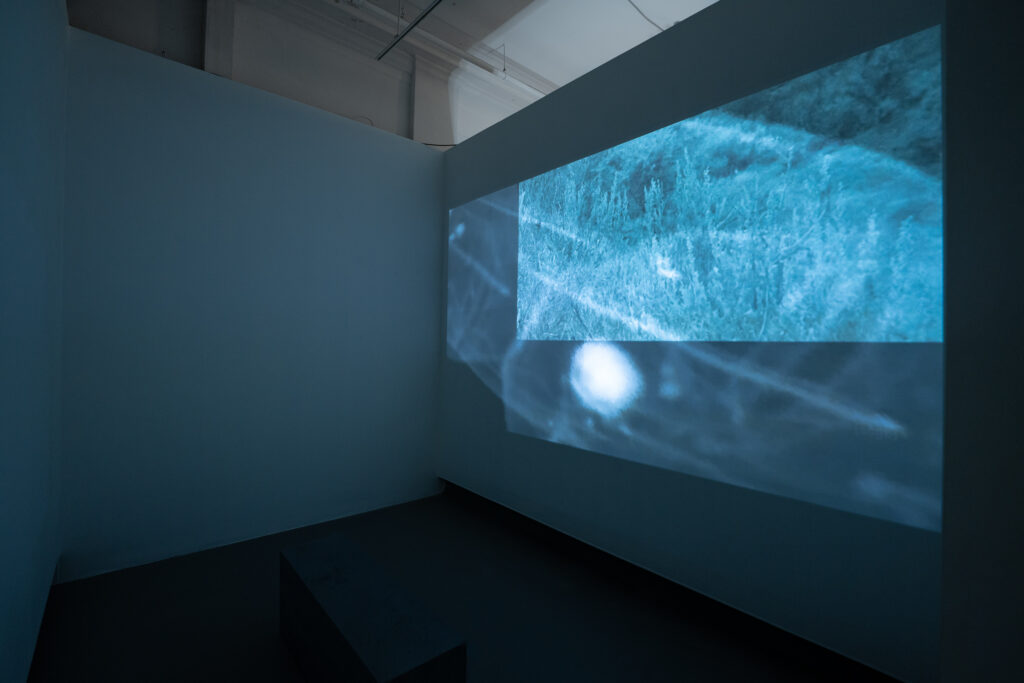
![An exhibition view of Sara Smith's Red Spruce Salt Marsh Station installation, chronicling her research into Inside the Breath (In Network Time), at SPACE in Jan-Feb, 2026 [Photo by Joel Tsui / Art Archival]](https://space538.org/wp-content/uploads/2026/06/tsui-6-4-1024x640.jpg)
SPACE: Did you draw inspiration from Indigenous communities or pre-colonial communities in the United States? Did you do research into those traditions while developing the project?
Sara Smith: As I was doing research for the project, I looked into many different cultural understandings of interconnection. Some of it involved Indigenous American cosmologies, which often function as forms of Indigenous science. There isn’t always the same distinction between cosmology and science within Indigenous knowledge systems. Those systems developed together over time.
I’m also from an Ashkenazi Jewish background, so I looked into Jewish ideas about interconnection and biological co-arising. I explored African concepts as well, including Ubuntu. What became clear to me is that almost every early culture had some understanding of humans as deeply embedded within a larger planetary system. There was a widespread recognition that we rely on systems of exchange with the world around us. It’s really European imperialism and Christian expansion that disrupted many of those understandings and introduced ideas of separation—heaven and earth, humanity and nature, culture and nature. What science is doing now is demonstrating and proving aspects of interconnection that many Indigenous cosmologies have understood all along.
That’s one of the things I find most interesting: that it’s taken 21st-century science to verify ideas that many people already knew. That realization wasn’t the sole origin of the project, but it’s definitely something I’ve continued reading and thinking about.
SPACE: If In Network Time is a destination of sorts, what have you learned while researching this vision of the future about how we might get there? How do we become more connected?
Sara Smith: For me, it comes back to building our capacity to tune into smaller forms of activity. Especially in America, we love big gestures. As humans, and particularly as people coming from settler-colonial lineages, I think we need to become quieter. We need to become more sophisticated in how we perceive what’s happening around us. One of the major things I’ve learned through researching biologies of connection and distributed consciousness is that we have to learn how to feel and connect with others. We have to center that activity. That’s what will allow us to enter In Network Time.
Sara Smith and The Network Time Small Human Chorus present Shift Again on Tuesday, June 30 at 7 pm at SPACE. Tickets are a $5 suggested donation, and free community tickets are available. More info here.
Shift Again is made possible with a New England Foundation for the Arts New England States Touring (NEST) grant.
